
Where Forgotten Becomes Forever
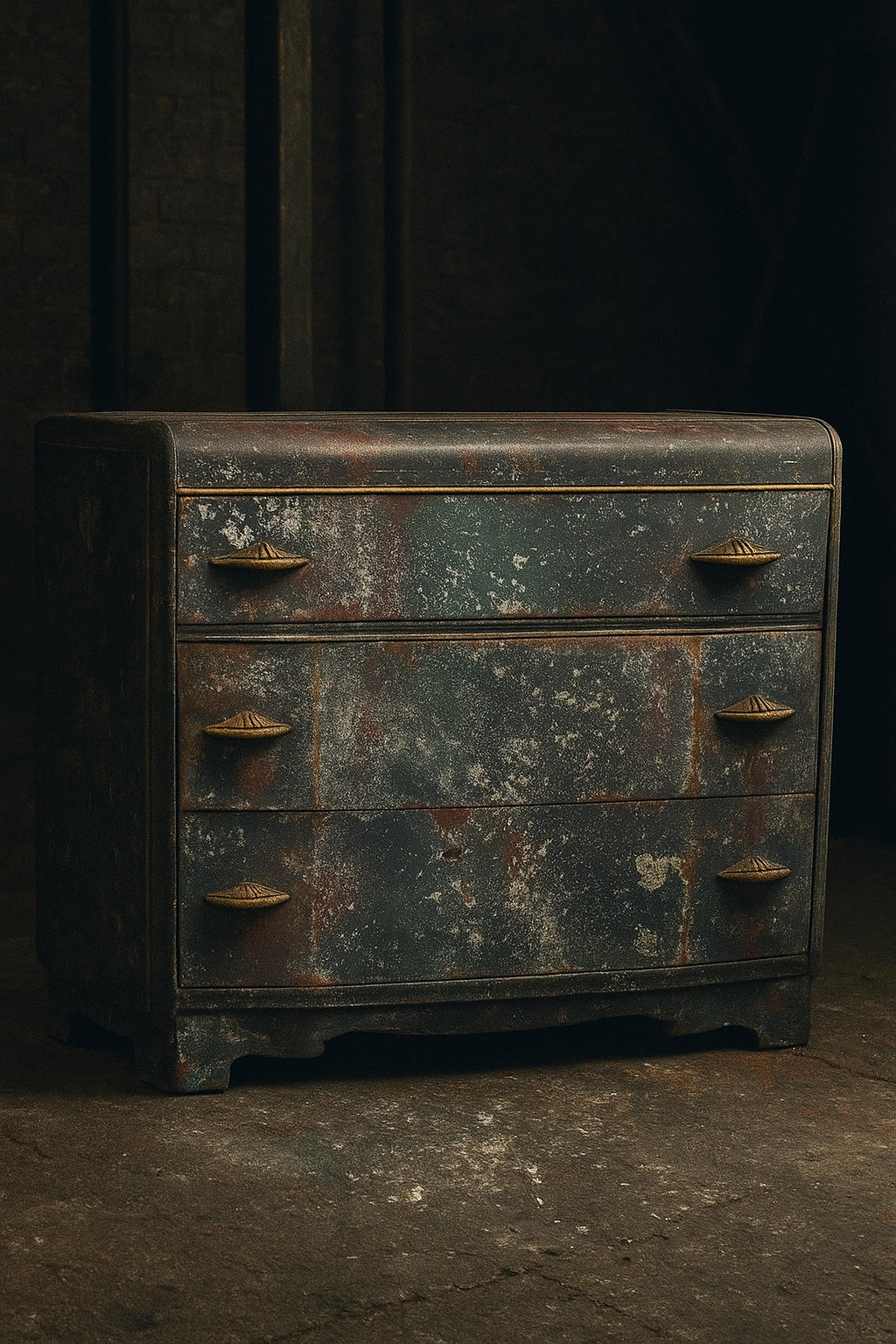
Material alchemy with saltwash patina & organic rust effects
Saltwash Patina Art Deco Chest of Drawers
This Art Deco chest represents a sophisticated exploration of texture, patina, and the poetic possibilities of unconventional materials. Through advanced surface treatments and organic pigmentation techniques, the artist has transformed a mid-century form into a contemporary meditation on oxidation, erosion, and industrial beauty.
Technical Process & Materials
Saltwash Patina - Primary Surface Treatment
The drawer fronts and body showcase a saltwash patina technique created through the application of plaster of Paris mixed with coarse salt. As the plaster sets around salt crystals, then the salt dissolves or is mechanically removed, it creates microscopic cavities and dimensional texture that mimics natural mineral deposits, coastal weathering, and archaeological surfaces.
This process produces authentic three-dimensional relief—valleys, peaks, crystalline patterns, and erosion marks—that cannot be achieved through painting alone. The result resembles aged fresco, weathered maritime structures, or oxidized architectural metals.
Color Layering - Annie Sloan Chalk Paint
Three Annie Sloan Chalk Paint colors build chromatic depth:
- Scandinavian Pink — Muted dusty rose providing warmth within the cool-toned palette
- Oxford Navy Blue — Deep mineral blue suggesting verdigris and aged indigo
- Old White/Cream — Luminous base layer creating depth and suggesting multiple paint histories
These colors are glazed, dry-brushed, and strategically revealed through the saltwash texture, creating organic variation that shifts with lighting and viewing angle.
Organic Rust Effect - Cinnamon & Turmeric
The six fan-shaped brass handles feature rust patina created with cinnamon and turmeric rather than chemical accelerators or acrylic paints. This organic approach produces:
- Authentic textured deposits and dimensional variation
- Complex earth tones (sienna, burnt umber, orange-rust, golden oxidation)
- Non-toxic, archival finish that continues to subtly evolve
- Realistic visual and tactile qualities
Gilding - Annie Sloan Gold Wax
Strategic applications of Annie Sloan Gilding Wax catch light across edges and raised textures—not the shine of new gilt, but the subtle memory of former decoration mostly worn away.
Protection - Multiple Wax Layers
The entire piece is sealed with several layers of Annie Sloan Clear Wax, providing durability for functional use, enhanced color depth, and subtle sheen while maintaining a natural, matte appearance.
Form & Dimensions
Art Deco construction (circa 1930s-1940s) featuring:
- Waterfall edge top and sides
- Bowed (curved) drawer fronts
- Fan-shaped brass pull handles
- Solid wood construction
- Three spacious drawers
Artistic Context
This work sits at the intersection of furniture restoration and contemporary surface art. The techniques employed—particularly the saltwash patination and organic rust effects—represent material innovation within the furniture arts community.
The saltwash process involves controlled variables but unpredictable outcomes. Salt crystallization, plaster absorption rates, and environmental conditions at the moment of creation produce unique surface patterns. Even using identical materials and methods, the artist cannot replicate exact results—each piece becomes singular.
The use of food-grade spices (cinnamon, turmeric) for rust effects demonstrates creative problem-solving and represents an emerging approach within eco-conscious furniture finishing.
Artistic Singularity: The unpredictable nature of the saltwash crystallization process means this exact surface pattern cannot be replicated—making this piece truly one-of-a-kind.
Placement & Styling
The piece works across diverse aesthetic contexts:
- Industrial spaces — Emphasizes oxidation and rust alongside exposed brick, metal, concrete
- Romantic interiors — Highlights the pink undertones and gilding with textiles and soft lighting
- Minimalist settings — Functions as sole dramatic element in restrained environments
- Eclectic collections — Holds visual weight amid layered, maximalist arrangements
- Traditional rooms — Art Deco bones and gilding allow conversation with period antiques
The complex color palette (blues, greens, rust, pink, cream, gold) functions as sophisticated neutral, complementing rather than competing with surrounding elements.
Care & Maintenance
- Dust with soft, dry cloth
- Buff wax finish occasionally to restore luster
- Avoid direct sunlight and high moisture areas
- Clean spills immediately with slightly damp cloth
- Re-wax every few years to maintain protection
Fully functional for daily use. The sealed finish protects the artistic surface while allowing normal storage use.
Final Note
This chest offers three drawers of storage within a surface that rewards sustained attention. The textured topography, organic color shifts, and dimensional rust effects reveal new details over time rather than exhausting visual interest upon first viewing.
For those who appreciate material craft, surface complexity, and the marriage of function with artistic technique, this represents a considered acquisition.