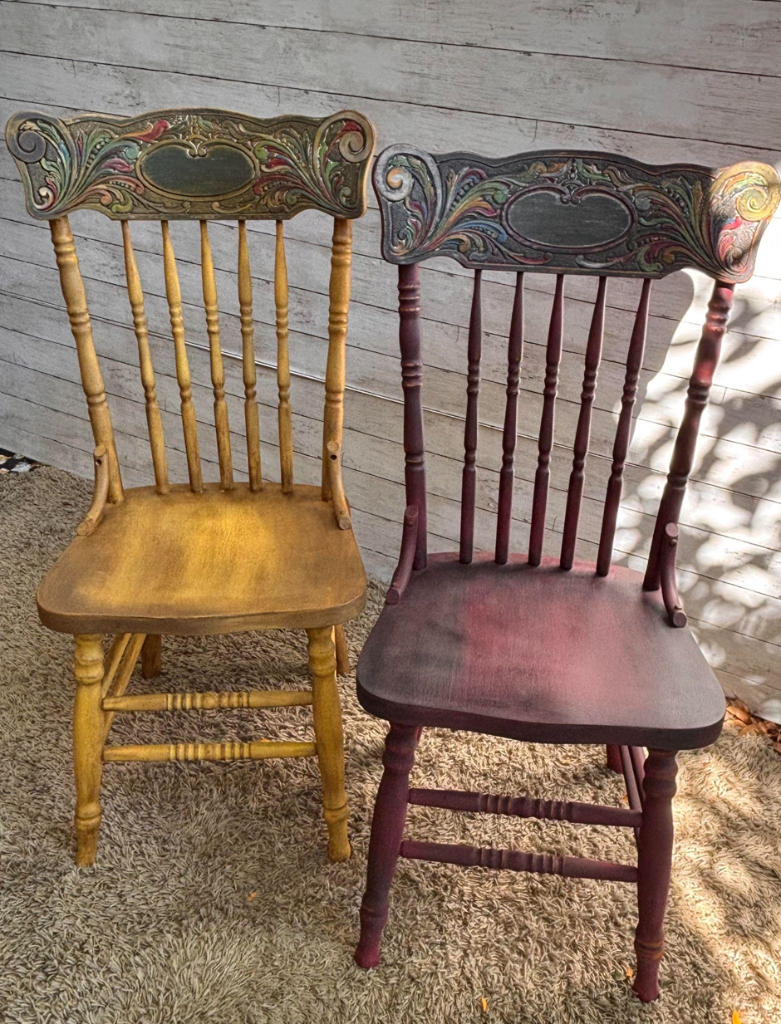
Some chairs are merely functional seating. Others become small canvases where craft meets daily life. These country farm chairs with their elaborate carved backs transform from simple utilitarian pieces into artistic statements through careful painting that honors rather than obscures their ornate original carvings.
The Form: Country Pressed-Back Chairs
These chairs represent a beloved American furniture type: pressed-back or embossed chairs popular from the late 1800s through the early 1900s. Originally mass-produced using hydraulic presses that stamped elaborate designs into steam-softened wood, these chairs brought decorative elegance to farmhouses, kitchens, and dining rooms at accessible prices.
Ornate Crest Rail
Flowing scrollwork, acanthus leaf motifs, and a central oval medallion creating a baroque-inspired composition
Spindle Construction
Multiple vertical turned spindles providing structural support while maintaining visual lightness
Turned Legs & Stretchers
Traditional bead-and-reel or ring turnings adding dimensional detail throughout the chair structure
Solid Wood Seats
Shaped for comfort, sturdy enough for generations of daily use
These weren't precious parlor furniture but working chairs meant for kitchens and dining tables, which makes their elaborate backs all the more charming. They brought beauty into everyday spaces.
Two Distinctive Colors
Tilton in Golden Amber
Annie Sloan's Tilton, a warm golden tone that sits between honey amber and antique gold. This isn't bright yellow or orange but rather a sophisticated aged gold that suggests old pine furniture, amber-toned varnish mellowed over decades, or autumn light captured in paint.
The color creates warmth and approachability, the kind of tone that makes a kitchen feel welcoming or a dining area feel lived-in rather than formal.
Clear and dark wax enriches the golden tone, adding depth and subtle aging. The dark wax settles into carved details, creating shadow and dimensional emphasis that makes the chair appear as though it has always been this color.
Rodmell in Burgundy Wine
Annie Sloan's Rodmell, a deep, sophisticated burgundy with wine-red richness and subtle purple undertones. This isn't bright red or pink but rather a complex, mature color suggesting aged Bordeaux, burgundy velvet, or the deep red-browns found in antique textiles.
Rodmell transforms the chair's character entirely. Where Tilton creates warmth and casual elegance, Rodmell introduces drama and richness. The color has weight and presence, making the chair feel more formal and artistic.
Clear and dark wax deepens the Rodmell color and adds aged character, with dark wax creating contrast that makes the ornate back carving read more clearly.
The Hand-Painted Carved Details
The most distinctive feature of these chairs is the multi-color hand-painting of the carved back details. Rather than leaving the elaborate pressed designs as monochrome elements, the artist treated each carved motif as an opportunity for color accent.
Across both chair backs, the carved scrollwork, acanthus leaves, floral elements, and decorative borders receive individual color treatment. The palette includes vibrant reds, rich greens, warm golds, soft corals, and other accent colors that create a folk art or narrowboat painting aesthetic.
Visual Clarity
Each carved element becomes distinct and legible. What might read as busy relief carving transforms into a clear composition where individual motifs stand out.
Handcrafted Character
The chairs gain personality. They no longer feel mass-produced but rather individually decorated by an artisan.
Visual Joy
These become chairs that make people smile, that children remember, that guests comment on.
Folk Art Connection
Connects to European decorative traditions: Bavarian painted furniture, Scandinavian rosemaling, English canal boat art.
The hand-painting requires patience and a steady hand. Each carved ridge, each leaf tip, each scroll curve receives its own color carefully applied to stay within the carved boundaries. This isn't quick work but rather meditative craft requiring hours of detailed painting across the complex relief surfaces.
"The hand-painting requires patience and a steady hand. Each carved ridge, each leaf tip, each scroll curve receives its own color—hours of meditative craft across complex relief surfaces."
Why Two Different Base Colors Work
Offering these chairs in two distinct base colors (Tilton gold and Rodmell burgundy) rather than as identical pieces creates interesting possibilities:
As a Pair
The chairs complement each other through their shared ornate form and multi-color painted details while creating visual interest through contrasting base colors. Perfect for eclectic or bohemian aesthetics.
As Individuals
Each chair stands complete on its own, functioning as an accent piece. Choose based on your existing palette or aesthetic preference.
As a Beginning
Acquire one of each, then potentially commission additional chairs in the same or complementary colors to build a custom dining set over time.
The Folk Art Tradition
The multi-color painting of these carved chair backs connects to rich decorative traditions:
- American folk art — Rural artisans decorated utilitarian objects with vibrant painted designs
- Pennsylvania Dutch hex signs — Colorful geometric and floral symbols on barns and furniture
- Narrowboat art — Elaborate painted decoration on English canal boats with roses, castles, and scrollwork
- Scandinavian rosemaling — Norwegian decorative painting featuring flowing floral designs
- Bavarian bauernmalerei — German farmer's painting tradition with folk motifs in bright colors
These traditions share common principles: taking time to beautify functional objects, using color generously, celebrating craft skill, and creating objects that bring daily joy rather than being reserved for special occasions.
Placement & Styling
These chairs work across surprisingly diverse contexts:
Country Kitchens
Classically appropriate form with personality beyond typical farmhouse neutrals
Eclectic Dining
Mix with other chairs around a farm table. The ornate backs hold their own in visually rich spaces
Bedrooms
As accent seating, vanity chairs, or beside-the-bed perches
Home Offices
Desk chairs with personality that inspire creativity
Entryways
Creating a welcoming spot for putting on shoes or setting down bags
Children's Rooms
Folk art details and sturdy construction make these wonderful for kids' spaces
Tilton chair coordinates with: Warm wood tones, cream and ivory textiles, earth tones (terracotta, ochre, rust), botanical greens, brass or copper metals.
Rodmell chair works with: Jewel tones (emerald, sapphire, gold), rich neutrals (charcoal, taupe, cream), warm metals (brass, bronze, aged gold).
Sold as Pair or Individually
These chairs are available as a pair (one Tilton, one Rodmell) for those wanting complementary seating with visual interest, or individually for those seeking a specific color or accent piece.
Care & Maintenance
Regular Maintenance
Dust with soft, dry cloth weekly, paying attention to carved back details
Use soft brush (clean paintbrush or makeup brush) for intricate carved areas
Buff gently with clean cloth monthly to maintain the waxed finish's subtle sheen
Painted Surfaces
Annie Sloan Chalk Paint finish sealed with clear and dark wax for protection
Wipe spills immediately with barely damp cloth, then dry thoroughly
Don't scrub or use abrasive materials on painted areas
Hand-Painted Details
These colorful accents are delicate artwork—avoid aggressive cleaning
Use barely damp cotton swab for carved recesses, dry immediately
Never drag chairs across rough surfaces that could abrade the finish
Protection & Re-waxing
Avoid direct sunlight which can fade colors over time
Re-wax every 1-2 years with thin layer of clear furniture wax
Keep in moderate humidity and stable indoor temperature
With proper care, these chairs will serve for decades, continuing to bring color, craft, and personality to daily life while maintaining their structural integrity and artistic beauty.