
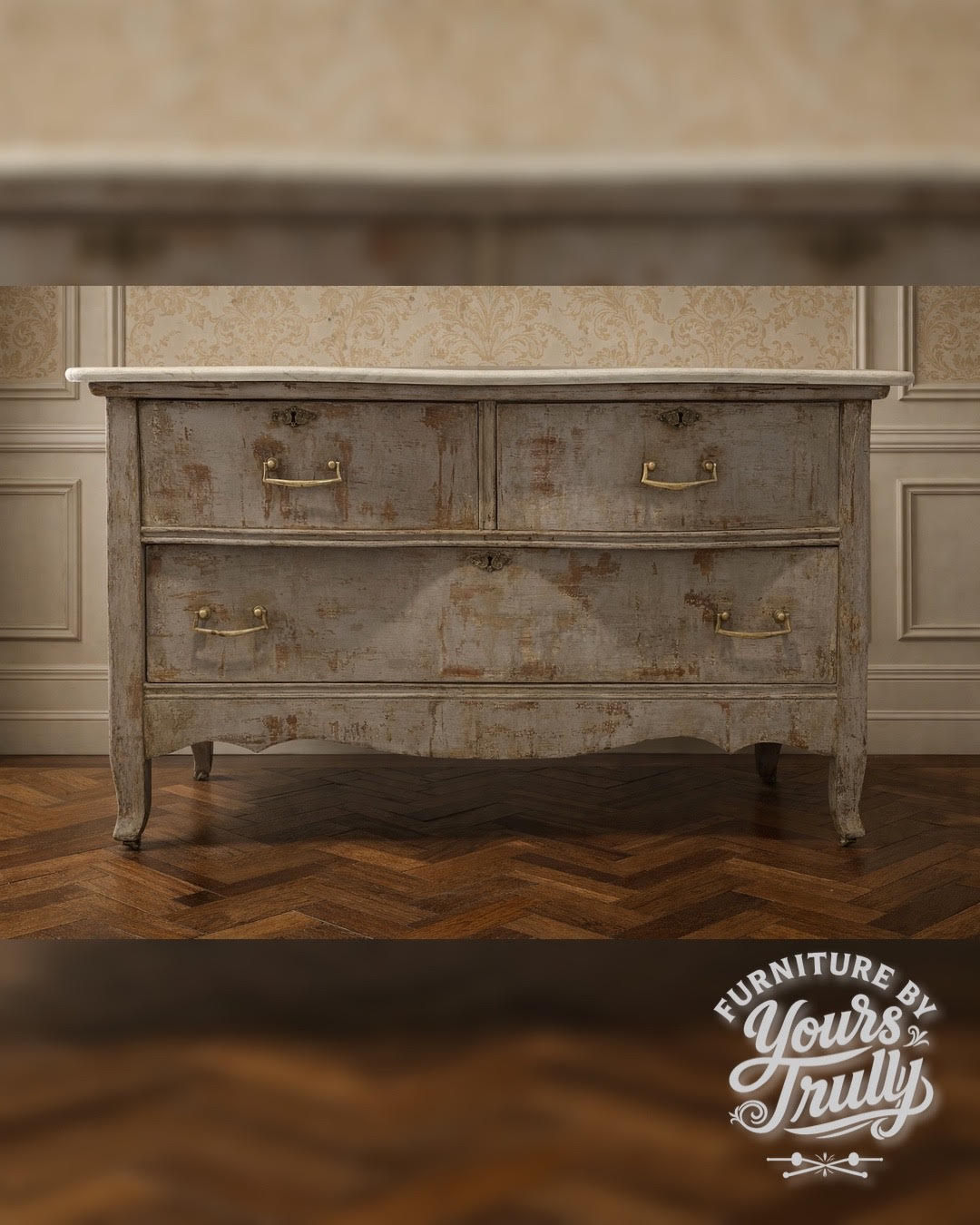
French Provincial Chest with Faux Marble Top
Ancient Tuscan Alchemy Meets Contemporary Craft
There's a moment when fire meets centuries-old materials and time collapses. What emerges looks less like furniture restored and more like furniture excavated, as if this French Provincial chest spent two hundred years in a Provençal farmhouse before someone discovered it behind crumbling plaster walls.
The artist created this illusion through Patina Toscana, the demanding Tuscan fire technique learned during residency with Dario Biagioni in Florence, Italy, one of the world's masters of traditional Italian decorative arts and natural material finishing.
🇮🇹 The Dario Biagioni Lineage 🇮🇹
To study with Dario Biagioni in Florence is to enter a lineage of craft knowledge stretching back through generations of Italian artisan-decorators. His workshops don't teach formulas or shortcuts; they transmit understanding developed over centuries about how natural materials behave, how fire transforms surfaces prepared with traditional mediums, how to create the appearance of time's passage through controlled destruction.
The artist brought this Florentine education to this French form, creating a piece that bridges two great European furniture traditions: French Provincial elegance and Italian decorative mastery.
Natural Materials: The Foundation
Before fire ever touched this chest, the artist built a complex foundation using traditional natural materials that have served Italian decorators for centuries. These preparations are not merely paint but alchemical mediums combining:
- Rabbit skin glue — Traditional binding agent
- Gypsum — Mineral base for preparations
- Earth pigments — Natural colors from clay and minerals
- Clay compounds — Providing texture and tooth
- Traditional lacquers — Natural protective layers
Each layer required specific preparation, application technique, and drying time. Each was sealed with natural glue before the next layer could be applied, creating genuine stratification that reads authentically when fire later reveals these underlayers.
No acrylics, no synthetic binders, no modern shortcuts. This is furniture finishing as it was practiced in Renaissance Italy, adapted to contemporary hands but faithful to historical materials and environmental principles.
Why Natural Materials Matter
The artist's commitment to natural, traditional materials reflects:
- Environmental stewardship: Natural materials carry minimal environmental impact, biodegrade, contain no VOCs
- Historical authenticity: Using the same materials that 18th century artisans employed
- Craft integrity: Working with natural materials demands deeper knowledge and skill
- Superior aging: Natural materials continue to cure and develop patina over years
- Reduced carbon footprint: Locally sourced, minimal industrial processing
The Layering and Firing Process
The artist began with bare wood and built up multiple layers of traditional preparations. Between each natural material layer, traditional glue sealing locked in that stage, creating genuine stratification.
Only the final visible layer consisted of modern material: Annie Sloan Chalk Paint in Antoinette, that soft dusty rose-pink named for Marie Antoinette. This top coat provided the warm romantic tone that characterizes French Provincial furniture.
Open flame application created:
- 🔥 Areas where Antoinette pink burned away, revealing earth-toned preparations
- 🔥 Zones where heat darkened the pink without removing it
- 🔥 Patches where traditional materials bubbled and crackled
- 🔥 Random patterns following the flame's path
- 🔥 Natural shadowing where flame lingered
After burning, scraping and revealing exposed the complex natural material history beneath. Final sealing with wax (a natural finish consistent with the traditional material philosophy) preserved the fire-created patterns.
The Result: Centuries Compressed
The surface carries visual complexity created through:
- Material authenticity: Using 18th century Italian decorator preparations
- Controlled destruction: Fire revealing genuine stratification
- Craft mastery: Understanding how natural materials behave under heat
- Environmental consciousness: Sustainable, low-impact materials throughout
- Historical knowledge: Techniques refined over generations
The Antoinette pink appears in varying degrees: more visible in protected areas, peeking through in worn spots, creating a warm romantic base tone that harmonizes with the exposed earth pigments.
The pink provides crucial warmth and softness, keeping the piece firmly in French Provincial territory: romantic, elegant, feminine.
The Faux Marble Top: Six Colors
Crowning the fire-distressed base sits an extraordinary hand-painted faux marble top created with six Annie Sloan Chalk Paint colors:
Six-Color Marble Palette:
- Original — Soft off-white base simulating marble's foundational color
- Cream — Warm ivory for highlights and subtle veining
- Graphite — Deep charcoal-gray for primary veining and depth
- Olive — Gray-green suggesting mineral deposits
- Scandinavian Pink — Subtle blush tones (iron oxide)
- French Linen — Sophisticated gray-taupe for mid-tones
The marbling process required building transparent layers that mimic stone's dimensional depth. Real marble contains subtle color shifts, warm and cool tones, opacity variations.
The marble effect provides crucial contrast: smooth against textured, cool against warm, pristine against aged, light against fire-darkened.
The French Provincial Form
Pure French Provincial Silhouette:
- Bombé front: Gently bowed, curved drawer fronts (signature sensuous curves)
- Cabriole legs: Gracefully curved legs with shaped feet
- Serpentine sides: Subtle curves flowing from front to back
- Shaped apron: Bottom edge curves organically
- Three drawer configuration: Two smaller over one wide (classic proportion)
- Original brass hardware: Bail pulls with decorative backing plates
This form originated in 18th century France during the Rococo period, when furniture abandoned straight lines in favor of organic curves inspired by nature.
The construction indicates quality: true bombé curves require skilled joinery and solid wood construction.
Italian Technique on French Form
This chest marries both traditions: French Provincial elegance with Italian decorative mastery. It could exist in a renovated Tuscan farmhouse or a French country estate with equal authenticity while representing modern commitment to sustainable craft practices.
The Unrepeatable Nature
Even if the artist approached another identical chest using the same natural material preparations and fire technique, the result would differ. Fire doesn't burn uniformly.
This chest is singular. The exact configuration of burned areas, revealed natural material underlayers, fire-created textures, and marble veining pattern belong only to this piece.
Investment in Mastery and Values
This chest represents:
- Traditional Italian craft education from acknowledged master
- Commitment to natural, sustainable materials
- Hundreds of hours: preparing natural materials, layering, firing, marbling
- Material quality: Traditional preparations + Annie Sloan finishes
- Historical furniture form with genuine carved curves
- Dual mastery: destructive (fire) and constructive (marble) techniques
- Functional beauty: three substantial drawers
- Reduced environmental footprint through natural materials
Care Instructions
This chest has been through intentional fire after preparation with centuries-old natural materials. Treat with respect.
Daily Maintenance
- Dust with soft, dry cloth regularly
- Use gentle brush for textured, fire-distressed areas
Fire-Patinated Base
- The rough, burned texture is intentional—don't attempt to smooth it
- Surface is sealed with natural wax; buff occasionally
- Don't use harsh cleaners or scrub distressed areas
- Exposed natural material layers are part of the aesthetic
Faux Marble Top
- Wipe with barely damp cloth when needed, dry immediately
- Use coasters under glasses and trivets under hot items
- Never use abrasive cleaners or scrubbing pads
General Protection
- Avoid direct sunlight
- Keep in moderate humidity
- Lift to move—don't drag
- The curved legs and fire-affected surfaces require gentle handling
What NOT to Do
- Never sand, scrub, or attempt to "restore" the fire-created patina
- Don't use chemical cleaners or synthetic furniture polish
- Don't attempt DIY repairs—requires specialized knowledge of traditional materials
With respectful care, this chest will maintain its extraordinary character for generations, continuing to appear as if it survived centuries when it's actually been reborn through contemporary craft mastery honoring both historical techniques and environmental responsibility.