
Where Forgotten Becomes Forever
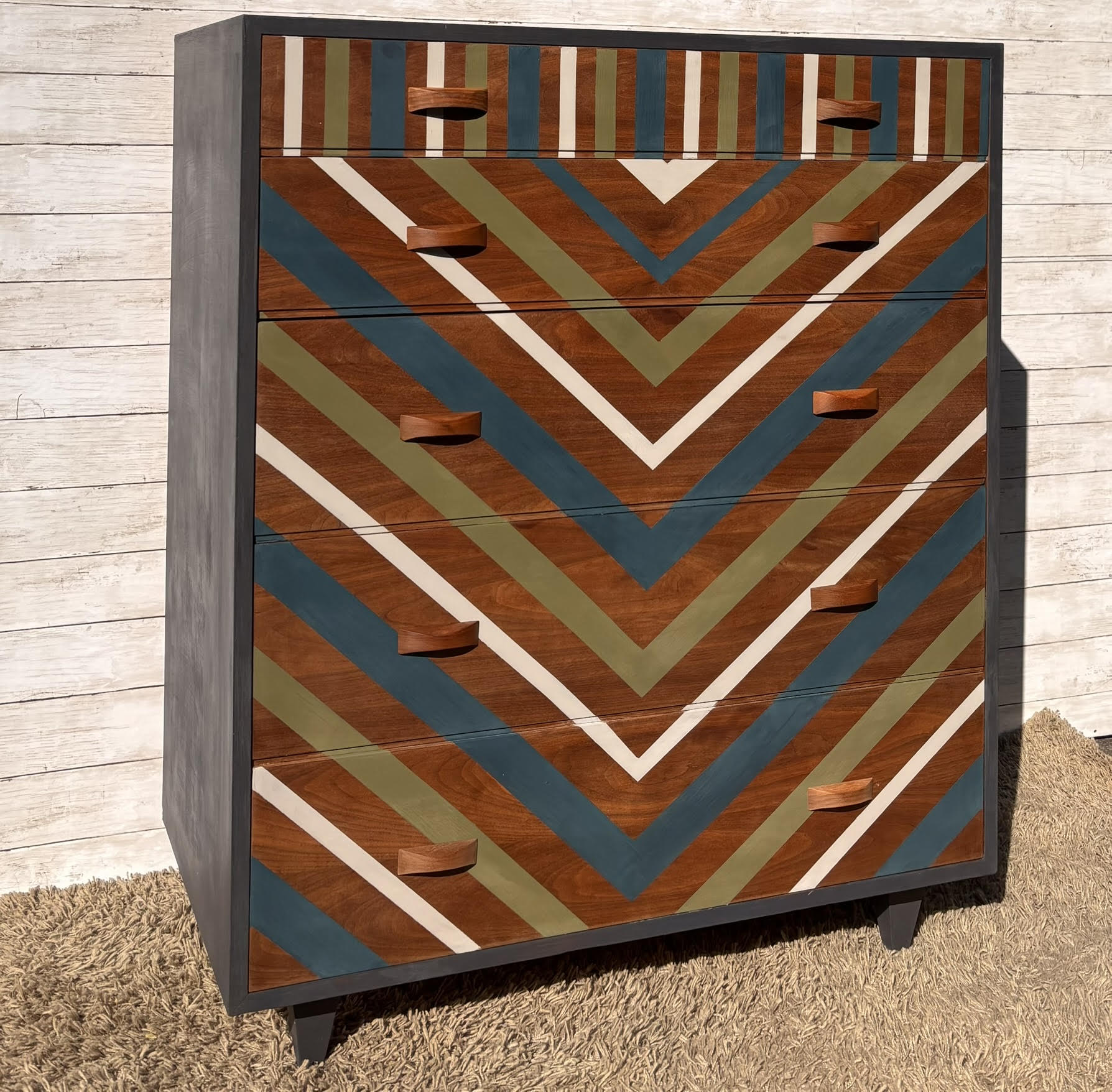
Precision geometry meets natural wood grain
Geometric Chevron Dresser
A Study in Pattern, Precision, and Material Dialogue
The chevron has always been a restless pattern—arrows pointing downward, lines converging and diverging, energy in motion even when standing still. On this five-drawer dresser, that geometric energy meets something unexpected: the quiet warmth of natural wood grain flowing through painted bands like rivers cutting through striated stone.
The Pattern's Logic
The artist stood before this dresser with painter's tape, a ruler, and a vision of how angles could transform a simple storage piece into something worth studying. The chevron pattern radiates from a central axis, each V-shaped band carefully measured to align across five separate drawer fronts. When the drawers close, the pattern reads as continuous—a single composition interrupted only by the shadow lines where drawer meets frame.
The top drawer breaks the rhythm intentionally. Clean vertical stripes in rust-brown wood, deep Aubusson blue, muted olive, and cream establish a different cadence before the chevrons take over below. It's a visual prelude, setting up the pattern logic that will dominate the remaining four drawers.
Annie Sloan Chalk Paint Colors
- Aubusson Blue — Complex blue-green that refuses to be simply navy or teal, holding depth that shifts with changing light
- Olive — Gray-green bridge between cool blue and warm wood tones, preventing stark contrast while maintaining definition
- Original White — Cream-ivory providing brightness without harshness, softening the geometry
- Natural Wood — Warm amber grain flowing through the pattern as an equal participant
But the fourth color—the warm amber of the wood itself—might be the most important. The artist chose not to cover everything, instead letting the wood grain flow through the pattern as an equal participant. Where paint stops, wood continues. The pattern exists with the material, not imposed upon it.
The Craft Behind the Lines
Creating geometric patterns on furniture requires a particular kind of patience. Each stripe and chevron band demands precise masking—tape laid down with attention to angles, pressed firmly to prevent paint bleeding beneath edges, removed at exactly the right moment in the drying process.
The chevrons present additional complexity. They must align not just within each drawer but across all five, despite the fact that these drawers open independently and may never sit at quite the same depth again. The artist had to account for drawer spacing, calculate angles that would meet properly at seams, and paint each section knowing it would only reveal its success or failure when all drawers were closed together.
Artisan Precision: The edges are crisp. No wavering lines, no places where hand-steadiness failed or tape lifted prematurely. This speaks to experience—knowing how much paint to load on the brush, how to approach a taped edge, when to apply second coats.
The recessed wooden handles continue the minimalist approach. Simple rectangular cutouts become part of the geometric composition rather than applied hardware fighting for attention. Your hand finds them naturally, and they disappear visually into the pattern.
The Frame as Boundary
The dresser's exterior—top, sides, and frame—wears a coat of matte Graphite that recedes into the background, creating a gallery-like border around the patterned drawer fronts. This wasn't accident or afterthought. The dark frame does critical work: it contains the visual energy of the chevron pattern, provides rest for the eye, and makes the drawer fronts read as a unified composition rather than separate elements.
Without this boundary, the pattern might feel unfinished, bleeding to the edges without resolution. The charcoal frame gives it definition, like matting around a print or the negative space that makes sculpture comprehensible.
Form & Proportions
Mid-century modern construction featuring:
- Five graduated drawers
- Solid wood construction
- Recessed wooden handles
- Matte graphite frame
- Nearly square face proportions (ideal for geometric work)
Where Natural and Manufactured Meet
There's an ongoing conversation in furniture making about whether to celebrate or conceal the base material. Do you cover wood completely with paint, treating it as mere substrate for decoration? Or do you let the grain show through, acknowledging what the piece fundamentally is?
This dresser takes a third path: strategic integration. The wood grain isn't accidentally showing through thin paint—it's deliberately preserved within the geometric pattern as a designed element. Paint and wood alternate in the chevron bands, creating visual texture that goes beyond color alone. You see not just rust-brown but figured wood grain in rust tones. Not just pattern but material pattern interacting with manufactured pattern.
This approach requires the artist to work with what the wood offers—its grain direction, color variation, any figuring or character marks—rather than fighting against it. The result feels more honest, more grounded, less like decoration applied to a generic form.
Living With Geometry
Bold patterns can be risky in furniture. What feels exciting initially might become visually exhausting over time, or limit how you can evolve the surrounding space. This dresser navigates that risk through its earth-toned palette and organic wood integration.
The colors—deep teal-blue, muted olive, warm wood, soft cream—function together as a sophisticated neutral despite their pattern. They don't compete with wall colors, textile choices, or artwork. Instead, they provide a complex but grounded visual anchor that other elements can play against.
- Bedroom: Provides storage while giving the space a focal point beyond the bed
- Entryway: Makes immediate impression while offering practical drawer space
- Living areas: Breaks expectation that storage furniture should apologize for its presence
- Studios: Combines function with visual interest in creative spaces
The Palette's Particular Appeal
Aubusson blue, olive, wood-amber, and cream—this combination speaks several aesthetic languages simultaneously. There's something of the American Southwest in these tones, desert landscapes and Native textile patterns. Something of mid-century Scandinavian design in the restrained palette and celebration of wood. Something contemporary in the graphic boldness and precision.
The palette avoids the trap of trend. These aren't the colors of a particular design moment that will date the piece. They're earthy, elemental tones that could have been chosen in 1965 or 2025, that work with both vintage and contemporary furnishings.
What Distinguishes This Work: The pattern complexity demonstrates design sophistication. The alignment across multiple drawer fronts shows technical skill. The decision to preserve wood grain reveals aesthetic confidence. The sealed, protected finish indicates understanding of durability and longevity.
A Singular Object
No factory produced this pattern. No algorithm generated these measurements. One person planned, measured, masked, painted, and finished this specific dresser, making hundreds of small decisions that accumulated into the object before you.
The chevron angles, the color choices, the decision about where to preserve wood and where to apply paint, the stripe pattern on the top drawer, the charcoal frame—each of these represents a choice point where the outcome could have been different.
The exact grain pattern of this wood, the particular way these chevrons align, the specific patina this piece will develop with time and use—these belong only to this dresser.
Presence Without Pretension
What makes this dresser compelling is the balance it strikes between confidence and restraint. The pattern is bold without being aggressive. The preserved wood keeps it grounded. The craftsmanship shows without showing off. The scale is substantial without being domineering.
It's furniture with a point of view—clearly someone made deliberate choices here—but it doesn't demand that everything else in the room defer to it. It can anchor a space while allowing other pieces to have their own character.
For those drawn to pattern and geometry, to the intersection of craft and design, to furniture that rewards sustained attention rather than exhausting interest quickly—this represents thoughtful work, properly executed, ready to inhabit a space that values both function and form.
Care & Maintenance
- Dust with soft, dry cloth
- Buff wax finish occasionally to restore luster
- Avoid direct sunlight and high moisture areas
- Clean spills immediately with slightly damp cloth
- Re-wax every few years to maintain protection
Fully functional for daily use. The sealed finish protects the artistic surface while allowing normal storage capacity across five drawers.