
Where Forgotten Becomes Forever
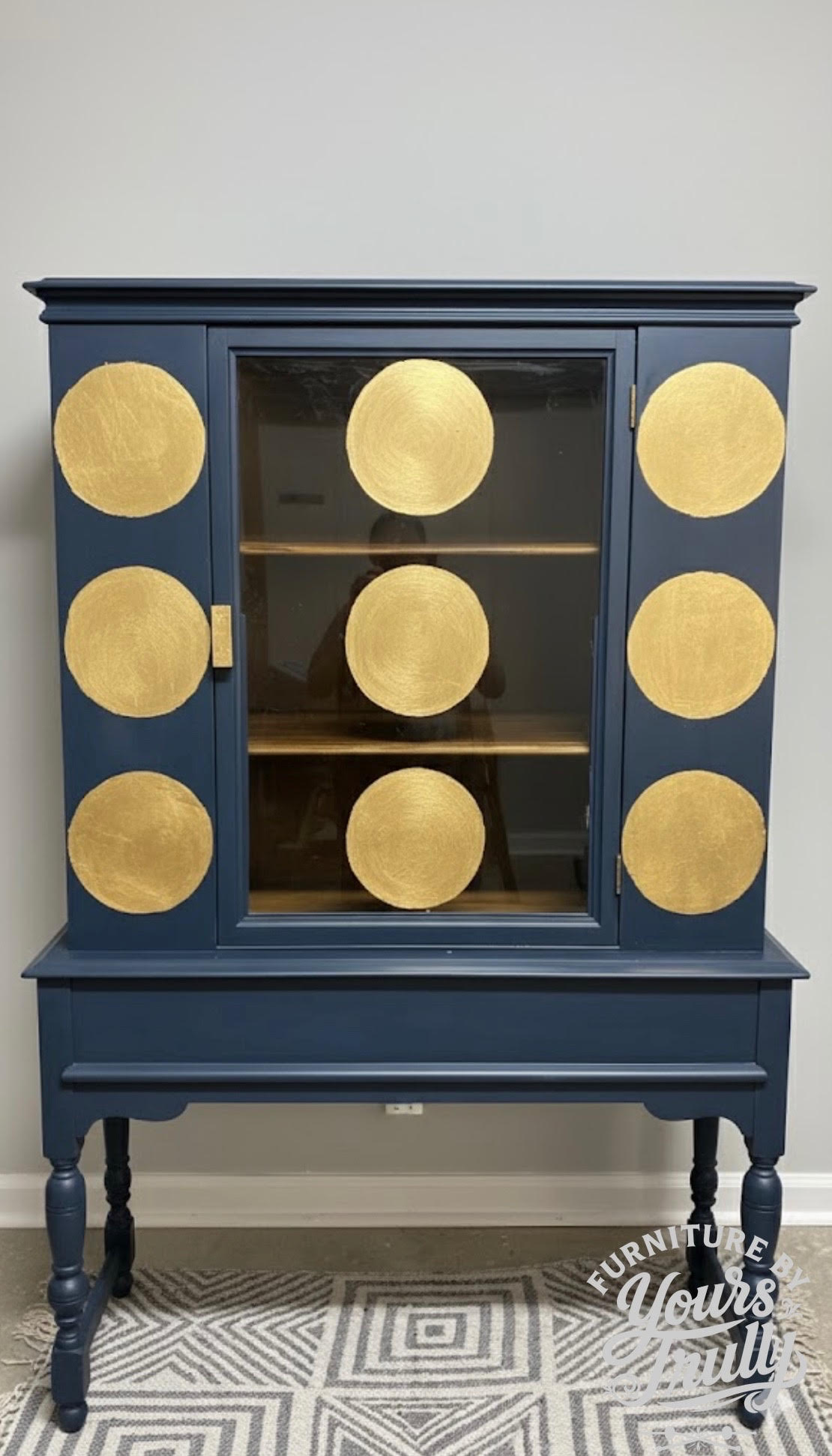
Nine gold leaf spheres on midnight blue—celestial geometry captured
Gold Sphere Cabinet on Stand
Celestial Geometry Meets Eastern Elegance
Nine perfect circles of luminous gold float against deep midnight blue—a constellation captured in furniture form. This transformed cabinet doesn't whisper for attention; it commands it through the timeless language of geometry, the ancient allure of gold leaf, and the sophisticated tension between Eastern aesthetic philosophy and contemporary boldness.
The Vision: East Meets Statement
The artist drew inspiration from Chinese decorative arts—the circular motifs that appear in lattice screens, porcelain patterns, jade carvings, and silk textiles. In Chinese symbolism, the circle represents heaven, completeness, unity, and the eternal cycle.
The Symbolism of Nine Circles
Nine circles carry particular significance in Chinese culture: the number nine (jiǔ) symbolizes longevity and eternity, considered the most auspicious of numbers.
But this isn't reproduction or pastiche. The artist took that symbolic vocabulary and translated it into something unmistakably contemporary: bold scale, dramatic color contrast, unapologetic symmetry.
The result bridges centuries and cultures—ancient symbolism rendered in a visual language that feels entirely now.
Midnight Blue: Depth and Drama
The entire cabinet—doors, sides, top, base, and turned legs—wears several coats of Fusion Mineral Paint in midnight blue. Not navy, not royal blue, but that particular shade that sits at the edge of black, holding just enough blue to read as color rather than neutral.
Fusion Mineral Paint Benefits
- Built-in topcoat (no separate sealing required)
- Exceptional adhesion and durability
- Smooth, self-leveling application
- Rich, saturated pigmentation
- Low VOC, environmentally conscious formulation
The midnight blue creates a dramatic stage for the gold spheres—dark enough to make the metallic elements appear to glow, sophisticated enough to work in formal spaces, bold enough to anchor eclectic or contemporary rooms.
The color evokes night sky, deep water, luxury, mystery—all the associations that make dark blues perpetually appealing. It's the color of velvet curtains in old theaters, of Chinese export porcelain, of evening gowns and gemstones.
Gold Leaf Spheres: Light Made Tangible
Nine perfect circles—three on each door panel, three visible through the glass center panel—have been hand-applied in genuine gold leaf. Not gold paint. Not metallic wax. Actual sheets of gold leaf, impossibly thin, laid down with traditional gilding techniques.
The Gold Leaf Process:
- Surface prepared perfectly smooth (any imperfection shows through)
- Adhesive sizing applied—specialized glue that remains tacky
- Gold leaf sheets, so thin they tear if breathed upon, gently pressed onto circles
- Leaf carefully burnished to bring up characteristic warm glow
- Excess leaf brushed away, gold sealed to protect from tarnishing
The Magic of Real Gold Leaf: Circles that catch and reflect light like captured suns, their warm glow shifting as you move or as daylight changes. Real gold leaf has luminosity that metallic paint cannot replicate—it doesn't just reflect light but seems to hold it, radiating warmth.
The perfect circular forms create rhythm and balance. Your eye travels across them in orderly progression—three down the left door, three on the center glass, three down the right door. The symmetry is satisfying, meditative even, recalling the ordered cosmos of Chinese cosmology.
The Cabinet Form: Display and Concealment
This is a china cabinet or display cabinet—the traditional form designed to showcase precious objects while protecting them behind glass.
Structure & Architecture
Upper Cabinet Section:
- Three doors (two solid side panels, one central glass panel)
- Glass shelving visible through center door
- Oiled wood interior (natural grain preserved)
- Framed panel construction with classical proportions
Lower Base Section:
- Single drawer for concealed storage
- Scalloped apron adding graceful detail
- Four turned legs in traditional baluster style
- Raised platform creating visual lift
The turned legs are particularly important—they reference traditional furniture craftsmanship, keeping the piece grounded in furniture history even as the bold decoration pushes it toward art object.
Interior Treatment: Oiled Wood
Open those doors and you discover a different world. Where the exterior is bold and contemporary, the interior shelving and back panel have been treated with wood oil, preserving and enhancing the natural grain.
This interior treatment serves multiple purposes:
- Practical: Oil protects from moisture, condensation from vases or plants
- Aesthetic: Warm natural wood creates beautiful contrast—surprise warmth against cool exterior
- Respectful: Honors original wood rather than painting over, maintaining material history
Protective Wax Finish
The entire exterior—midnight blue paint and gold leaf spheres—has been sealed with protective wax, providing:
- Enhanced durability against fingerprints, scuffs, and daily wear
- Subtle depth making midnight blue appear more saturated
- Sophisticated matte-satin finish
- Gold protection against tarnishing
- Smooth, pleasant tactile experience
- Easy maintenance—waxed surfaces dust easily and buff beautifully
What This Piece Does in a Room
- Creates instant focal point: Gold-on-midnight combination commands attention—becomes the room's visual anchor
- Provides display opportunity: Glass center showcases collections, decorative objects, personal treasures
- Offers concealed storage: Solid side doors and lower drawer for practical needs
- Bridges styles: Chinese symbolism meets contemporary boldness and traditional cabinet form
- Reflects light: Nine gold spheres animate throughout the day—catching morning sun, evening lamp glow
- Adds luxury: Gold leaf and midnight blue signal sophistication and intentional design
Styling Possibilities
- Dining room: Display fine dishes, glassware, serving pieces—midnight blue beautiful with white china or crystal
- Living room: Bar cabinet with bottles creating displays, or showcase books and art objects
- Entryway/hallway: Dramatic first impression with seasonal décor or travel treasures
- Bedroom: Display jewelry, accessories, perfumes—luxurious finish suits bedroom elegance
- Office/library: House special books, awards, framed photos—sophisticated palette for professional spaces
- Eclectic spaces: Bold statement holds its own among pattern, color, and abundant décor
- Minimalist spaces: Single dramatic element in restrained room—has presence to carry space alone
The color palette—midnight blue and gold—works with jewel tones, neutrals, earth tones, metallics, and bold colors. Remarkably versatile across design aesthetics.
The Singular Nature: The gold leaf application ensures this cabinet is unrepeatable. Each circle was gilded by hand—slight variations in how leaf catches light, micro-texture of burnished surface, exact edges where gold meets blue—these cannot be duplicated with precision.
Investment in Presence
This isn't subtle furniture that blends quietly into a room. This is a piece that shapes the space around it, becomes a reference point for other design decisions, that guests remember and comment on.
The combination of traditional form, classical Chinese symbolism, contemporary color boldness, and luxury materials creates something that defies easy categorization—not quite antique reproduction, not purely contemporary, not strictly Asian-inspired, not conventionally Western.
It occupies its own aesthetic territory, which means it brings personality and distinction wherever it's placed.
For those who appreciate furniture as more than storage solutions, who understand that the objects we live with shape our daily experience, who value craftsmanship and meaningful design—this cabinet offers all of that wrapped in celestial geometry and captured light.
Care & Maintenance
- Dust regularly with soft, lint-free cloth (microfiber recommended)
- Buff waxed exterior every 3-6 months with clean cloth
- Re-wax every 1-2 years with quality furniture wax
- Gold leaf: dust gently, avoid abrasive cloths or chemical cleaners
- Interior: Re-oil wood every 1-2 years to maintain protection
- Avoid direct sunlight, high moisture areas, harsh chemicals
With proper care, this piece will maintain its dramatic beauty for decades, continuing to function as both furniture and art.