
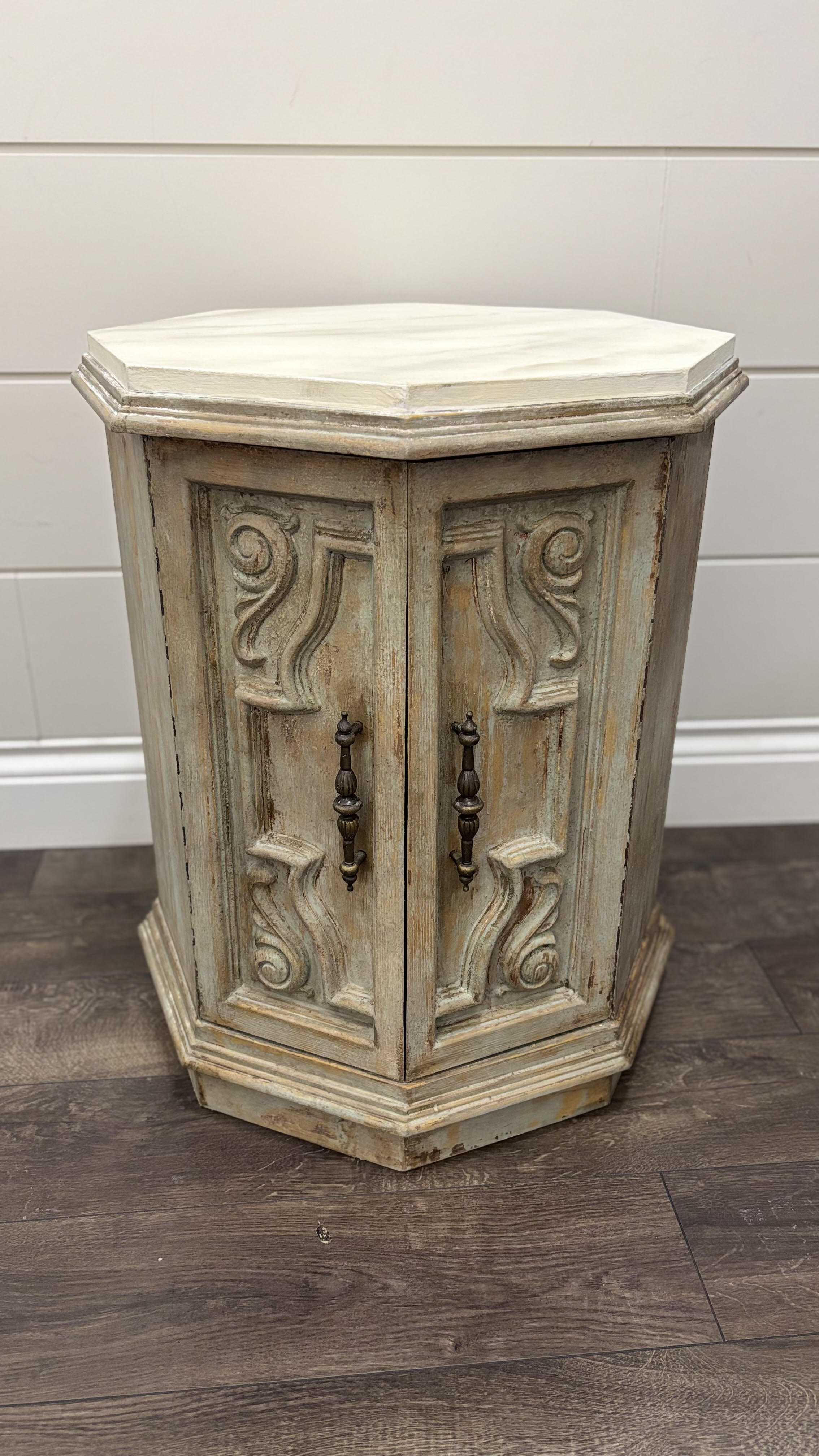
Octagonal Carved Cabinet with Faux Marble Top
Tuscan Fire Patina Meets Ancient Craft
Some furniture techniques can be learned from books or videos. Others require standing beside a master in their workshop, watching flames lick across painted surfaces, understanding through repetition and failure when to advance the fire and when to pull back.
This octagonal carved cabinet carries the mark of Patina Toscana—a centuries-old Tuscan finishing technique involving controlled fire—learned by the artist during residency with Dario Biagioni, one of Italy's guardians of traditional decorative arts.
🔥 Patina Toscana: The Fire Technique 🔥
Patina Toscana (Tuscan Patina) is not a paint color or a distressing method. It's an alchemical process where fire transforms painted surfaces into something that resembles furniture excavated from Pompeii or retrieved from a Florentine palazzo's forgotten storage room.
This cabinet demonstrates mastery of a technique that cannot be rushed, mechanized, or replicated through ordinary distressing methods. Each piece finished with Patina Toscana is singular—fire creates patterns that can never be exactly duplicated.
The Fire Technique Process
The technique involves several critical steps:
- Multiple paint layers applied in specific color sequences—typically earth tones, creams, and grays that will interact meaningfully when partially burned away
- Controlled burning using open flame (a torch) passed carefully across the painted surface. The fire doesn't engulf or char the wood—it selectively burns the paint layers
- Immediate intervention as the artist watches the paint react to heat, knowing precisely when to extinguish or move the flame
- Scraping and revealing after controlled burning, removing loosened paint to expose the layered history beneath
- Sealing the complex surface to preserve the fire-created patterns while adding subtle sheen
What Fire Creates:
- Areas where paint bubbles and crisps
- Zones where top layers burn away revealing underlayers
- Patches where paint darkens from heat exposure
- Edges where flame creates natural shadowing
- Random patterns impossible to replicate through mechanical distressing
The result mimics millennia of aging—the kind of surface complexity that develops on furniture surviving centuries in unheated stone buildings, exposed to temperature fluctuations, humidity changes, and the accumulated effects of time.
The Dario Biagioni Residency
Dario Biagioni is a master of traditional Italian decorative painting techniques, working from Tuscany where these methods developed over centuries. Artists who study with him don't simply learn procedures—they absorb the philosophy of patient craft, the understanding that certain effects cannot be rushed or mechanized.
During Residency, the Artist Learned:
- Practiced color layering sequences specific to Tuscan decorative traditions
- Learned to read how different paint formulations react to flame
- Developed the courage to apply fire to hours of careful painting work
- Understood the balance between control and acceptance of unpredictability
- Studied antique furniture to internalize what genuine age looks like
- Absorbed the Italian approach to patina—celebrating rather than disguising age
Replicating Ancient Surfaces
Creating furniture that appears to have survived since the Renaissance requires more than technical skill—it demands understanding what happens to painted wood over centuries:
- ✦ Environmental exposure: Temperature and humidity fluctuations cause paint to crack in specific patterns
- ✦ Layer archaeology: Furniture repainted multiple times develops geological strata
- ✦ Wear patterns: Paint wears first at high-touch points and remains protected in recesses
- ✦ Oxidation and darkening: Pigments shift over time; whites yellow, colors mellow
- ✦ Material interaction: Different substrates age at different rates
The fire patina technique compresses this centuries-long process into controlled moments, using flame to create authentic cracking patterns, genuine layer revelation, natural variation, and convincing darkness in recesses.
This cabinet could credibly claim 200-300 years of age based on surface appearance alone. That illusion represents mastery of material behavior and decorative history.
Italian Renaissance Heritage
The cabinet itself speaks Italian architectural language:
Form & Construction:
- Octagonal form: Eight-sided geometry references Renaissance fascination with mathematical proportion and classical ideals
- Deeply carved door panels: Baroque or Rococo-inspired scrollwork with S-curves and C-scrolls flowing vertically
- Layered moldings: The octagonal top features stepped moldings creating architectural complexity and shadow play
- Two-door cabinet: Symmetrical doors with ornate metal drop pulls (escutcheon-style handles)
- Substantial construction: Solid wood throughout, not hollow or lightweight construction
The form likely references Italian cassapancas (storage chests), credenzas (sideboards), or tabernacles (small devotional cabinets)—furniture types with centuries of design evolution in Italian workshops.
The Faux Marble Top: A Light Counterpoint
Crowning this dramatically aged base sits a hand-painted faux marble top in cool, pale tones created with Annie Sloan Chalk Paint. The marble effect provides crucial contrast:
- ✦ Visual relief: After the complex, dark, heavily textured base, the eye needs somewhere to rest
- ✦ Material variety: Wood, carved detail, fire-darkened paint, metal hardware, and simulated stone
- ✦ Lightness and lift: The pale top prevents the cabinet from feeling too heavy or dark
- ✦ Classical reference: Italian furniture historically incorporated marble tops
- ✦ Surface protection: The sealed painted marble provides a durable, easily-cleaned top surface
The marble veining (executed with feathers, sponges, or fine brushes) in soft grays and creams creates the appearance of Carrara or Calacatta marble—the white Italian marbles prized since Roman times and still quarried in Tuscany near where this patina technique originated.
The geographical and material connection is poetic—Tuscan fire patina on the base, Tuscan marble (simulated) on top, all executed by an artist who studied in the region where both stone and technique originated.
Where This Piece Belongs
- ✦ As sculptural art: This cabinet transcends mere furniture—it's a demonstration of traditional craft
- ✦ Formal interiors: The aged patina and carved details suit spaces with architectural character
- ✦ Eclectic spaces: The dramatic finish holds its own in maximalist rooms
- ✦ Unexpected modern contexts: Placed in minimalist contemporary spaces, this piece provides textural and historical contrast
- ✦ Bathrooms: The marble top makes thematic sense; the compact octagonal footprint fits tight spaces
- ✦ Bedrooms: Nightstand or accent storage with enough presence to anchor a sleeping space
- ✦ Entryways: Immediate impression of curated taste and appreciation for craft
- ✦ Living rooms: Side table, bar cabinet, display storage for meaningful objects
The fire-darkened patina works with earth-toned palettes, rich jewel tones, and surprisingly well with soft pastels (which gain depth against the aged backdrop). It provides visual weight and gravitas wherever placed.
The Unrepeatable Nature of Fire
Each pass of flame creates unique patterns based on:
- ✦ Exact flame temperature and distance
- ✦ How long heat is applied to each area
- ✦ Air currents affecting flame behavior
- ✦ Paint dryness and thickness variations
- ✦ Wood grain affecting heat absorption
- ✦ The artist's decisions in real-time response to what's happening
This cabinet is singular—related pieces might exist, but identical replication is impossible. The fire patterns, the specific areas of paint revelation, the exact tonal variations belong only to this piece.
Investment in Traditional Craft
Patina Toscana is a living tradition maintained by a small community of Italian artisan-teachers and their students worldwide. It represents:
- ✦ Centuries of accumulated knowledge about materials and their behavior
- ✦ Courage to apply destructive techniques (fire) to achieve constructive results
- ✦ Patience to learn through direct mentorship rather than quick tutorials
- ✦ Respect for historical furniture and the desire to honor rather than merely copy it
Care Instructions
This cabinet has already been through fire. Treat it with the respect you'd give genuinely antique furniture.
Daily Maintenance
- Dust with soft, dry cloth or gentle brush for carved details
- The fire-distressed surface is intentionally textured—don't try to "fix" rough or darkened areas
Faux Marble Top
- Wipe with barely damp cloth when needed, dry immediately
- Use coasters and trivets to protect the painted stone effect
- The sealed surface is durable but not indestructible
Fire-Patinated Base
- The complex surface is sealed with wax
- Buff occasionally with soft cloth to maintain subtle sheen
- Don't use harsh cleaners or attempt to "clean up" the intentional aging
Hardware
- Original metal pulls can be gently dusted
- If cleaning is needed, use appropriate metal cleaner carefully, avoiding the surrounding painted areas
Cabinet Doors
- Open and close gently—the carved panels and aged finish deserve respect
- If hinges squeak, apply a tiny amount of oil
- Check that hinges remain tight periodically
General Protection
- Avoid direct sunlight (can fade even intentionally aged finishes over time)
- Keep away from high moisture areas (excessive humidity can affect the finish)
- Moderate indoor humidity is ideal
- Lift to move—the octagonal form makes it somewhat top-heavy
Re-waxing (if applicable)
- If the piece was finished with wax, it can be re-waxed every 1-2 years
- Use clear furniture wax sparingly
- Apply with soft cloth, allow to cure, buff gently
- Be careful in carved areas—excess wax can accumulate in recesses
What NOT to Do
- Never attempt to sand or refinish—you'll destroy the fire patina
- Don't use chemical cleaners or abrasive materials
- Avoid placing in areas with dramatic temperature changes
- Don't overload the interior shelving beyond reasonable capacity
This cabinet will maintain its dramatic character for decades with respectful care that honors the traditional craft invested in its creation.