
Where Forgotten Becomes Forever
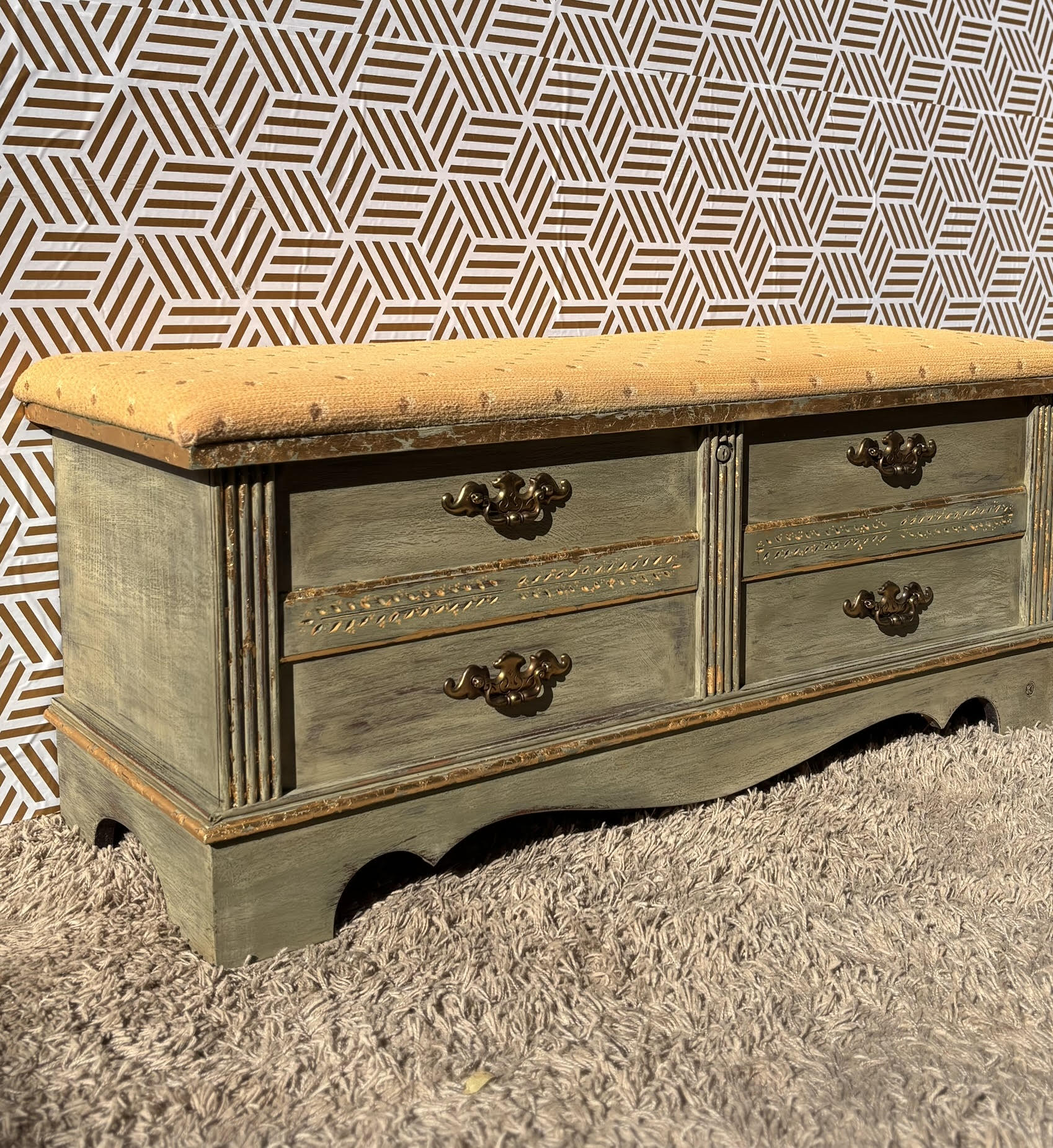
Candle wax patina with gold leaf accents & cushioned seating
Patina Cedar Storage Bench
Layers of Light, Time, and Transformation
There's a particular kind of magic that happens when candlelight meets layered paint—wax resists pigment in unpredictable ways, creating patterns that look less like decoration applied to a surface and more like history revealing itself through wear. This reimagined cedar chest carries that kind of surface, where technique and chance collaborated to produce something that feels both intentional and discovered.
The Candle Wax Patina Process
The artist approached this vintage cedar chest with candles, multiple colors of paint, and patience for a process that unfolds in stages, each dependent on the last.
How the Wax Resist Patina Works:
Step 1: A base layer of paint goes down—the sage-olive green that now reads as the dominant tone.
Step 2: Candle wax is rubbed selectively across surfaces—along edges, over decorative details, where natural wear would accumulate. The wax creates an invisible barrier.
Step 3: A second paint color is applied over the wax. Where there's no wax, paint adheres. Where wax was applied, paint sits on top but doesn't bond.
Step 4: After drying, the artist returns with fine steel wool or soft rags to remove the wax—and with it, the top layer of paint. What's revealed is the underlayer, creating the appearance of paint worn away through years of use.
Result: The process can repeat with multiple colors. Each layer adds complexity, depth, and the illusion of a long life lived.
Three Annie Sloan Chalk Paint Colors
- Olive — Sage-green base recalling painted furniture from European farmhouses or American colonial homes
- Tilton — Warm cream emerging in worn areas, suggesting an earlier lighter life
- French Linen — Sophisticated gray-taupe adding coolness and depth to the layered history
The result isn't uniform distressing. It's organic, varied, concentrated where hands would naturally grip and wear would naturally occur—along edges, around hardware, at corners. The pattern of reveal looks authentic because the technique mimics how paint actually fails over time.
Gold Leaf Accents: Light Captured in Metal
Along the borders—the decorative carved details, the scalloped base trim, the fluted corner pilasters—genuine gold leaf catches and holds light. Not the aggressive shine of new gilding, but the warm glow of old gold partially worn away.
This gilding serves multiple purposes:
- Elevates rustic farmhouse into refined elegance
- Creates visual pathways guiding the eye along architectural details
- Adds a third surface treatment (painted patina, natural wood, metallic accent)
- Echoes the vintage brass drawer pulls, creating harmonic unity
The Architecture of the Form
Beneath the patina work lives a vintage cedar storage chest with genuine architectural character:
- Scalloped base apron — Graceful curves from an era when utilitarian storage received decorative consideration
- Fluted corner pilasters — Vertical grooved columns adding dimensionality and classical design vocabulary
- Faux drawer fronts — Four drawer faces with brass pulls create dresser appearance, while top lifts for trunk storage
- Cedar interior — Aromatic wood provides natural moth-repellent protection for textiles
- Cushioned lift-top — Upholstered in textured mustard-gold fabric, transforming chest into functional seating
Dimensions & Proportions
Low and long profile—perfect for foot-of-bed, beneath windows, or along entryways:
The Upholstered Top: Warmth and Invitation
That mustard-gold cushioned top does important work. The warm, saturated yellow-gold provides color contrast against the cool sage-green base—complementary tones that energize each other.
But more importantly, the upholstery transforms the piece from storage box to furniture. It invites sitting—a place to perch while putting on shoes, a window seat for reading, extra seating when guests overflow, a landing spot for bags and packages.
Functional Transformation: The cushioning suggests comfort and consideration. This isn't a hard wooden surface grudgingly accommodating a body—it's a designed seating experience that happens to conceal spacious storage below.
Hidden Capacity
Lift that cushioned top and discover spacious cedar-lined trunk storage. At 44" wide × 16" deep with approximately 15" internal height, this chest holds:
- Extra blankets and quilts (cedar protects woolens naturally)
- Seasonal clothing during off-months
- Shoe storage (multiple pairs lying flat)
- Linens for guest beds
- Craft supplies, wrapping paper, seasonal decorations
- Documents, photo albums, keepsakes
The cedar lining isn't merely aesthetic—it's functional. The wood's natural oils repel moths and insects that damage textiles, making this ideal for storing woolens, cashmere, vintage clothing, or precious handmade quilts.
Layered History, Real and Imagined
The patina technique creates an interesting temporal paradox. This chest likely originated mid-20th century (1950s-1970s), but the surface treatment suggests something older: paint layers from multiple decades, wear from multiple lifetimes, accumulated patina of pre-war furniture.
The imagined history reads as authentic because the technique follows natural wear patterns. Paint thins where hands grip. Gold leaf remains in carved recesses but wears from flat surfaces. Colors show through suggesting repainting over original finishes.
This isn't historically dishonest—it's artistically honest: using contemporary techniques to create surfaces that carry emotional resonance and visual complexity, that feel like they have stories to tell even if those stories are conjured rather than lived.
Perfect Placement Options
- At the foot of a bed — Traditional placement offering seating while dressing and storage for bedding
- Entryway or mudroom — Landing spot for removing shoes with hidden storage for accessories
- Window seat area — Create a reading nook with built-in storage for books and throws
- Living room — Coffee table alternative or side seating, storing throws and media items
- Dining room — Extra seating when entertaining, storage for table linens and serving pieces
- Child's room — Toy chest with safe soft-top seating, cedar protecting special keepsakes
The color palette—sage green, cream, mustard gold, brass—works across multiple aesthetics: farmhouse, cottage, eclectic, vintage, transitional, and mid-century modern.
The Patina's Particular Appeal
Distressed and layered finishes solve a psychological challenge: how do we bring warmth, character, and visual interest into newer homes that lack architectural detail and accumulated history?
Furniture with complex surfaces adds temporal depth to a space. It suggests the room has evolved over time, that pieces were collected rather than bought as matched sets, that there's history and story beyond recent purchase.
The candle wax technique produces particularly convincing results because wear patterns emerge through actual physical process—wax really does resist paint, revealing underlayers creates real dimensional variation—rather than simply painting brown streaks where distressing "should" go.
Functional Beauty in Balance: The surface treatment is complex—three paint colors, wax resist, gold leafing, vintage hardware—but the form remains straightforward and functional. You can use this daily without worrying about damaging precious finish, because the finish already embraces the aesthetic of wear.
A Piece That Has Arrived
The surface doesn't look new or in-progress. It looks complete, settled, finished in the sense of having arrived at its intended character. You're not buying potential or project. You're acquiring furniture that appears to have lived a long life, absorbed stories, earned its character, and now stands ready to continue that journey in your home.
For those drawn to vintage aesthetics, those building homes with layered character, those needing actual storage and seating who refuse to sacrifice aesthetics for function—this proves you can have all three.
Care & Maintenance
- Dust with soft, dry cloth
- Buff wax finish occasionally to restore luster
- Avoid direct sunlight and high moisture areas
- Clean spills immediately with slightly damp cloth
- Re-wax every few years to maintain protection
Fully functional for daily use. The sealed finish protects the artistic surface while allowing normal storage and seating function.