
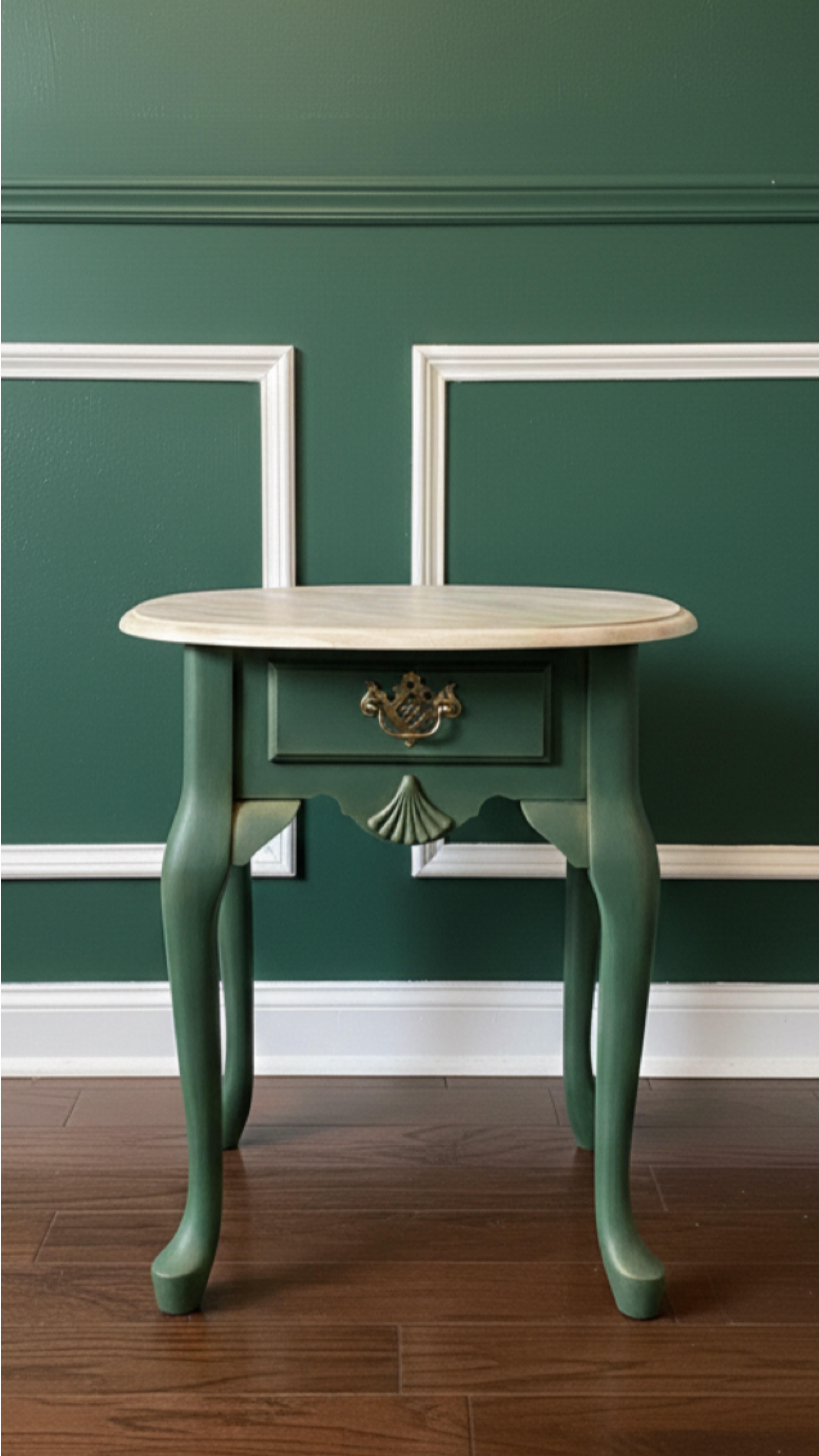
Queen Anne Side Table with Faux Marble Top
Amsterdam Green Elegance Meets Stone Artistry
Sometimes restraint speaks louder than embellishment. This petite Queen Anne side table demonstrates that principle—classic cabriole legs and a single drawer painted in deep Amsterdam Green, crowned with an extraordinary hand-painted faux marble top that required the kind of patience and skill most furniture painting never approaches.
The Color: Amsterdam Green
Annie Sloan's Amsterdam Green is neither forest nor emerald, neither teal nor olive. It's that particular blue-green that appears in 18th century Swedish manor houses, on Georgian paneled walls, in Victorian libraries—a color with gravitas and calm sophistication.
The artist applied this rich, complex green to the sculptural base—those gracefully curved Queen Anne cabriole legs with their characteristic pad feet, the shaped apron, the drawer front. The color settles into the curves beautifully, emphasizing the dimensional form through subtle shadow and highlight.
Golden wax applied over the painted surface adds warmth and depth—the wax catches slightly on edges and high points, creating a subtle antique glow that suggests age and careful preservation. It's the difference between flat paint and furniture that appears to have been cherished through generations.
The original brass hardware—a decorative bail pull with ornate backing plate—remains in place, its warm metal tone harmonizing perfectly with the golden wax and providing historical authenticity.
The Faux Marble Top: A Study in Patience
Look closely at that oval top. What appears to be genuine marble is actually hand-painted faux marbling—one of the most technically demanding decorative painting techniques, requiring understanding of stone formation, color theory, and the ability to build transparent layers that mimic mineral depth.
Six-Color Palette for Faux Marble
The artist used six Annie Sloan Chalk Paint colors to create this convincing stone surface:
The process involved:
Applying the base color, then building up translucent layers of veining using various tools—feathers, fine brushes, sea sponges, crumpled plastic—to create the organic, branching patterns that characterize natural marble. Each vein had to feel geological, not decorative. The colors had to blend and overlap as they do in actual stone formation where minerals flow through fissures and compress over millennia.
The result convinces from a distance and rewards close inspection—the veining follows natural logic, colors transition organically, the surface has depth and complexity that simple painting cannot achieve.
Multiple layers of protective wax seal this delicate work, creating a durable surface that can handle daily use while preserving the painted stone illusion. The wax also adds subtle sheen that mimics polished marble's satin finish.
Form and Function
This Queen Anne side table (circa 1920s-1950s reproduction of the 18th century form) offers:
- Oval top sized perfectly for beside a chair or bed (approximately 20-24" wide)
- Single drawer for small storage (remotes, reading glasses, notepads)
- Open lower shelf for books, decorative objects, or daily essentials
- Cabriole legs with pad feet—the signature Queen Anne silhouette
- Compact footprint ideal for small spaces
The proportions are refined—substantial enough to be functional, delicate enough to feel elegant. The height places the top at comfortable arm-reach from standard seating.
Where It Belongs
- Beside upholstered chairs — The classic placement, offering surface for drinks, books, lamps
- Bedroom nightstands — The drawer holds bedside necessities; the "marble" top elevates the room
- Entryways — Catchall for keys and mail, with decorative presence
- Bathrooms — The faux marble top makes thematic sense; storage for elegant toiletries
- Paired symmetrically — Flanking a sofa, bed, or fireplace
The Amsterdam green and marble combination feels both traditional and fresh—classic enough for formal spaces, confident enough for eclectic rooms.
Color Pairings
The Amsterdam Green works beautifully with:
- Warm woods and leather
- Brass and gold metals
- Cream, white, and neutral palettes
- Jewel tones (especially burgundy, navy, amber)
- Botanical greens and natural textures
The Craft Achievement
Faux marbling is experiencing renewed appreciation as a lost art. Few contemporary furniture painters attempt it because it's difficult, time-consuming, and unforgiving—mistakes are obvious, and convincing results require genuine skill.
This top succeeds because the artist understood marble's geological nature. The veining doesn't just sit on the surface; it appears to run through the stone. The colors don't compete; they interact as minerals do in natural formation. The overall composition has the balanced asymmetry of actual marble—patterns that feel random yet somehow inevitable.
Care Instructions
Regular Maintenance
- Dust with soft, lint-free cloth weekly
- Buff the waxed surfaces monthly with clean cloth to maintain subtle sheen
Top Surface (Faux Marble)
- The multiple wax layers protect the painted surface, but treat gently
- Use coasters under glasses and trivets under hot items
- Wipe spills immediately with barely damp cloth, dry thoroughly
- Never use abrasive cleaners or scrubbing pads
Painted Base
- Dust carved details and legs regularly
- Buff golden wax finish every 3-6 months to revive warmth
- Re-wax annually with clear furniture wax if needed
Drawer and Hardware
- Original brass pull requires only gentle dusting
- If drawer sticks, rub candle wax on runners
- Check hardware tightness periodically
Protection
- Avoid direct sunlight (can fade paint over time)
- Keep away from high moisture areas
- Lift to move (never drag—the delicate legs can be stressed)
Re-waxing (as needed)
- Apply thin layer of Annie Sloan Clear Wax with soft cloth
- Allow 5-10 minutes to cure
- Buff to desired sheen
- Pay special attention to the top surface, which sees most use
With proper care, both the Amsterdam Green finish and the faux marble top will maintain their beauty for decades. The wax protection ensures this refined piece serves as functional furniture, not merely decorative art.