
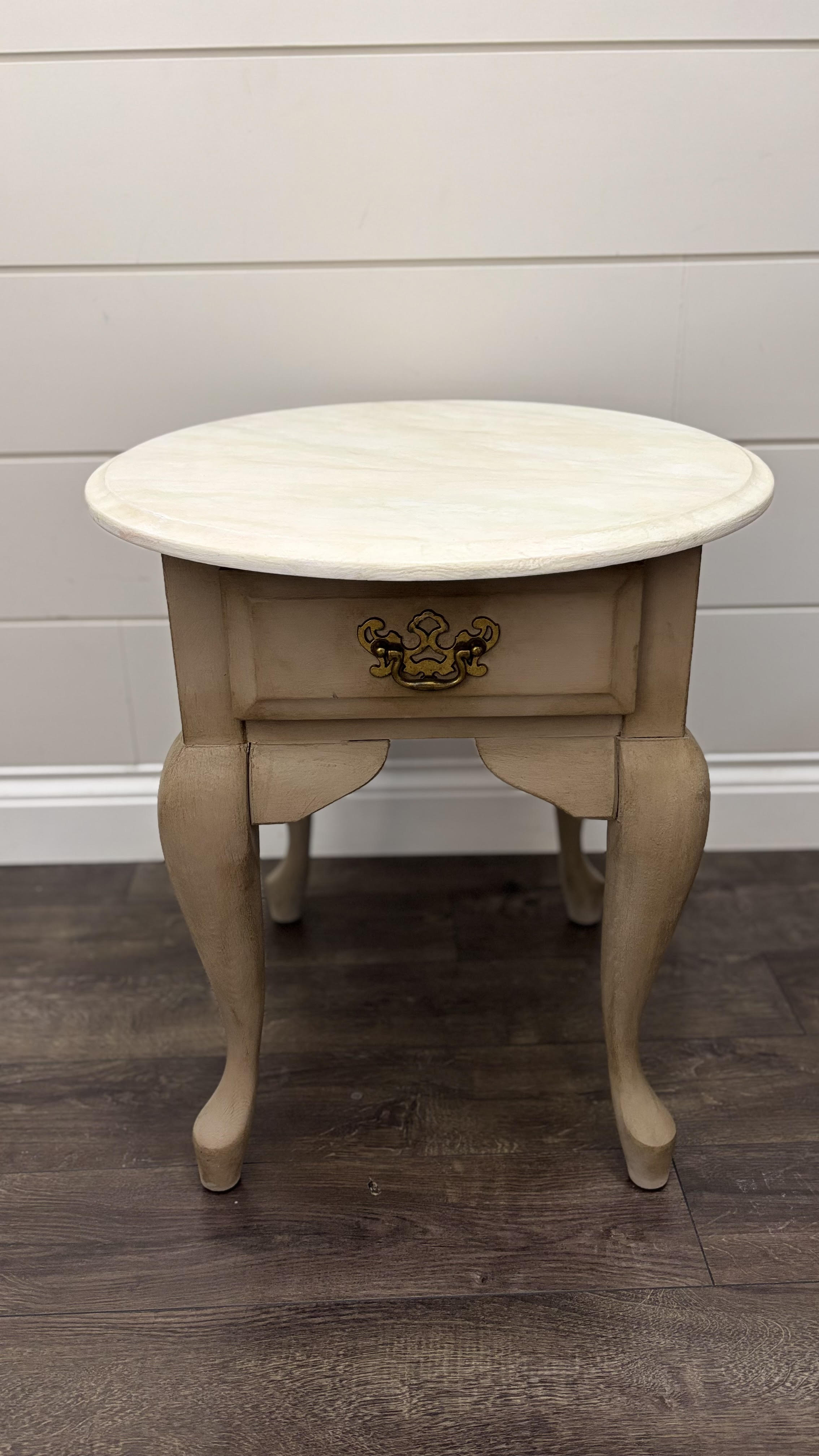
Queen Anne Side Table with Faux Marble Top
Coco Refinement and Feathered Stone
Subtlety has its own power. This petite Queen Anne side table speaks in whispers rather than shouts—neutral tones in Annie Sloan's Coco paint on gracefully curved legs, crowned with a hand-painted faux marble top created through the delicate art of feather veining. The result is furniture that fits anywhere while maintaining quiet sophistication.
The Color: Coco
The artist painted the base in Coco, one of Annie Sloan's most versatile neutrals—that perfect warm taupe-beige that's not quite gray, not quite brown, with subtle undertones that shift depending on surrounding light and colors. It's the color of natural linen, sun-bleached driftwood, aged parchment, café au lait.
Coco has the rare quality of enhancing rather than competing—it allows the sculptural form of the Queen Anne silhouette to take precedence while providing warmth that pure white or gray couldn't achieve.
Coco Creates:
- Complements virtually any palette
- Reads as warm without being yellow-toned
- Provides enough contrast against white trim without harshness
- Suggests age and patina without looking distressed
- Creates cohesion between the painted base and faux marble top
The artist applied this Annie Sloan Chalk Paint to the cabriole legs with their characteristic curves and pad feet, the shaped apron, and the single drawer front.
The original brass hardware—a decorative bail pull with ornate backing plate—retains its antique patina, the warm metal harmonizing beautifully with the Coco base.
The Faux Marble Top: The Feather Technique
The round top appears to be genuine stone—cool white marble with characteristic gray veining running through its surface. This is hand-painted faux marbling executed with one of the technique's most traditional and challenging tools: actual feathers.
The feather veining process is an art form dating back centuries:
After establishing the Original base color, the artist loaded a feather (a long, flexible feather from a bird's wing) with thinned Graphite paint. Holding the feather at an angle to the surface, they dragged and twisted it across the "stone," allowing the individual barbs of the feather to create the organic, branching lines that characterize natural marble veining.
Why Feathers Work So Well:
The natural structure of a feather—with its central spine and radiating barbs of varying lengths—creates exactly the kind of irregular, branching, softly-edged lines that appear in geological stone. No brush can replicate this effect.
- Organic irregularity: The veins branch, fork, thin, and thicken as geological veins do
- Soft edges: Real marble veining doesn't have hard painted lines
- Directional flow: The veining follows geological compression patterns
- Natural variation: No two vein lines are identical in width or opacity
- Restraint: The artist knew when to stop—providing interest without overwhelming
The feather flexes and bends as it moves across the surface, creating variation in line weight, subtle forks and branches, and the slightly ragged edges where mineral veins peter out in actual marble.
The artist had to work quickly while the paint remained workable, planning the overall vein pattern to follow natural stone logic—veins that branch and reconnect, that vary in thickness, that follow directional flow as if compressed by geological forces.
Multiple layers of protective wax seal the painted surface, providing durability for daily use while adding the subtle sheen of polished stone. The wax also deepens the colors slightly, enhancing the dimensional quality of the veining.
The Art of Feather Veining
Faux marble painting reached its zenith in 18th and 19th century European decorative arts, when skilled artisans created stone effects so convincing that only touch could reveal the deception. The feather technique was prized because it produced the most naturalistic veining.
The multiple protective wax layers not only seal and protect but also integrate the veining with the base color, creating the dimensional depth that makes the illusion work.
Form and Function
This Queen Anne side table (likely a mid-20th century reproduction of the classic 18th century form) offers:
- Round top (approximately 18-22" diameter) perfect for beside seating
- Single drawer for concealed storage—remotes, reading materials, small items
- Open lower shelf for books, decorative objects, or daily essentials
- Classic cabriole legs with pad feet—the signature curved silhouette
- Compact footprint ideal for tight spaces or paired placement
The height positions the top at comfortable reach from a standard chair or sofa. The round shape is particularly versatile—no sharp corners to navigate around, elegant from every angle.
Quality Foundation
Beneath the painted finish lives solid vintage construction:
- Traditional joinery in the drawer and frame
- Carved cabriole legs (not applied molding)
- Original brass hardware with ornate backing plate
- Sturdy proportions that have survived decades
The artist's work honors rather than conceals this quality—choosing techniques and colors that enhance the form rather than fighting it.
Neutral Sophistication
The Coco and white marble combination achieves something rare: strong visual interest through technique and form rather than bold color. This makes the table extraordinarily versatile.
It works in:
- Traditional spaces — The Queen Anne form and marble aesthetic fit naturally with antiques and classic décor
- Contemporary rooms — The neutral palette and clean execution suit modern minimalism
- Coastal interiors — The soft tones echo sand, driftwood, and weathered materials
- Transitional settings — Bridges traditional form with restrained contemporary color
- Monochromatic schemes — Adds texture and dimension without introducing new colors
- Any color palette — Coco works with literally everything—jewel tones, pastels, earth tones, black and white
Placement Possibilities
- Beside upholstered seating — The classic side table role, holding drinks, books, lighting
- Bedroom nightstand — Drawer for essentials, top for lamp and personal items
- Bathroom — Elegant storage beside a tub or as vanity-adjacent surface
- Entryway — Landing spot for keys, mail, decorative objects
- Paired symmetrically — Two flanking a sofa, bed, or fireplace create balanced composition
- Small space solution — The compact round top fits where rectangular tables won't
Care Instructions
Daily Maintenance
- Dust with soft, dry cloth regularly
- Buff gently with clean cloth monthly to maintain subtle sheen
Faux Marble Top
- Multiple wax layers protect the painted surface, but use coasters under glasses
- Place trivets under hot items
- Wipe spills immediately with barely damp cloth, then dry
- Never use abrasive cleaners, scrubbing pads, or harsh chemicals
Painted Base
- Dust carved leg details and drawer front weekly
- The Coco finish is sealed with wax—buff occasionally to maintain protection
- Re-wax every 1-2 years with Annie Sloan Clear Wax if needed
Hardware
- Original brass pull requires only gentle dusting
- If tarnish develops, clean carefully with brass polish, avoiding painted surfaces
General Protection
- Avoid prolonged direct sunlight (can fade paint over time)
- Keep away from high moisture areas
- Lift to move—never drag (protects delicate legs)
- Maintain moderate indoor humidity (excessive dryness or moisture affects wood)
Re-waxing Process
- Apply thin layer of clear furniture wax with soft cloth
- Work in small sections
- Allow 5-10 minutes to cure
- Buff to desired sheen with clean cloth
- Top surface needs most attention due to use
With proper care, both the Coco finish and the feather-veined marble top will maintain their refined appearance for decades. The protective wax ensures this piece functions as daily furniture while preserving the artisan finishing work.