
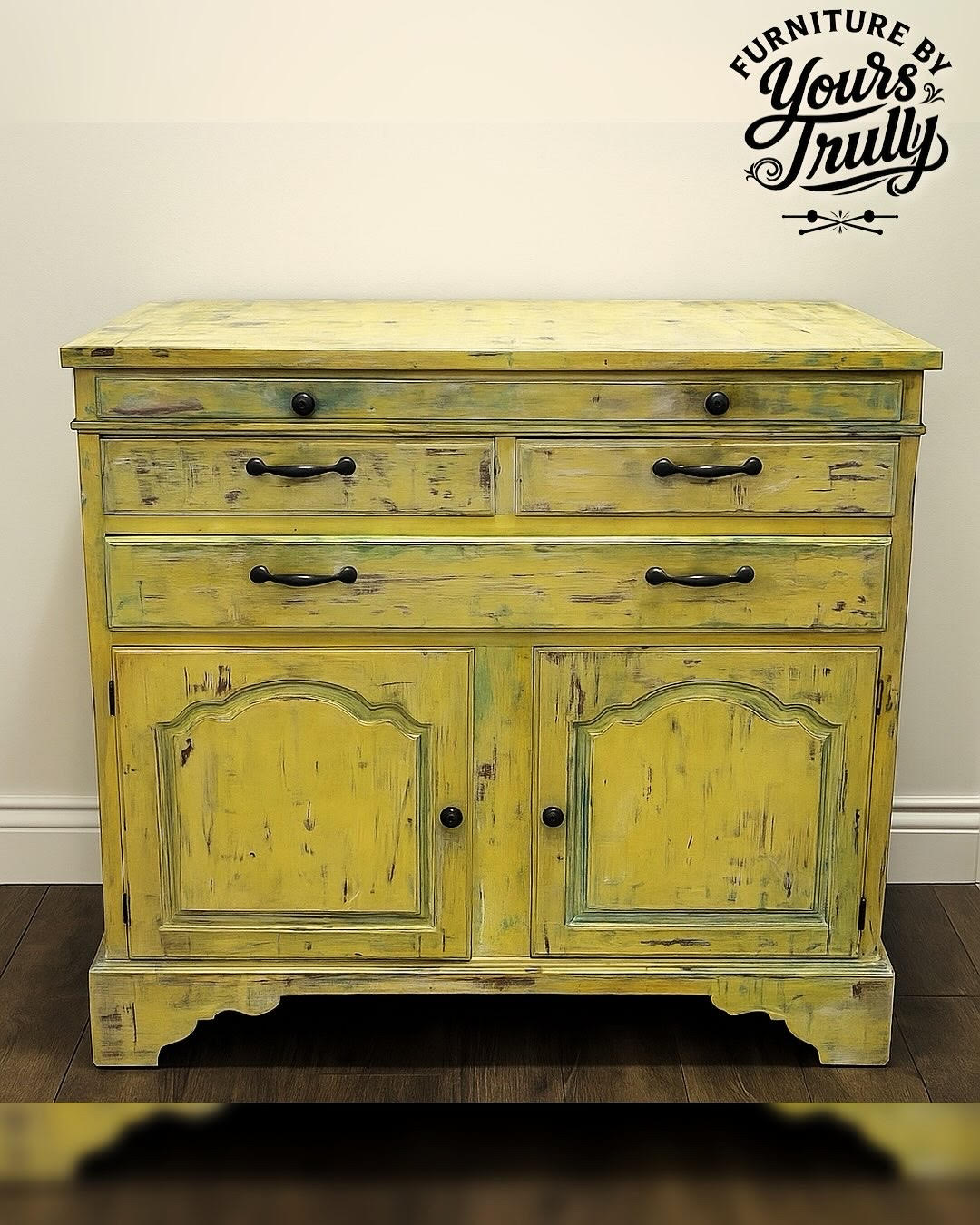
Wallace Nutting Breadboard Cabinet
Cherry Highlands Collection Reimagined in Sunlit Patina
There's a particular reverence required when approaching a Wallace Nutting piece. These aren't ordinary vintage cabinets—they're artifacts from America's Colonial Revival movement, crafted in the 1920s-1930s when Nutting's workshops produced museum-quality furniture inspired by 17th and 18th century New England forms. This breadboard cabinet from the Cherry Highlands collection carried that heritage, that solid construction, those hand-carved details.
The artist honored that provenance while giving it new life—transforming dark colonial formality into something luminous, layered, and utterly contemporary through sophisticated patina techniques and unexpected color.
The Wallace Nutting Legacy
For context: Wallace Nutting (1861-1941) was photographer, author, antiquarian, and furniture maker whose workshops in Framingham and Saugus, Massachusetts produced some of the finest American Colonial Revival furniture of the early 20th century. His pieces weren't reproductions in the cheap sense—they were carefully researched interpretations of period forms, built with traditional joinery, quality hardwoods, and attention to historical accuracy.
The Cherry Highlands collection featured solid cherry construction with characteristic elements visible on this piece:
- Raised panel doors with arched (cathedral) tops
- Breadboard top construction (wide boards with cross-grain end pieces preventing warping)
- Substantial bracket feet with scrolled cutouts
- Traditional drawer configurations
- Hand-finished details and quality hardware
The Transformation: Layered Color and Deliberate Distress
The artist approached this substantial piece with a sophisticated multi-layer technique that creates the appearance of a century of repainting, wear, and patina accumulation. Three Annie Sloan Chalk Paint colors build the surface story:
Color Palette
- English Yellow: The dominant tone, a saturated golden-yellow that recalls Italian villas, French country kitchens, early American painted furniture, and optimistic mid-century color choices
- Giverny: A soft sage-green with gray undertones. Named for Monet's garden village, this muted green-gray shows through in worn areas, suggesting an earlier paint life and adding cool contrast to the warm yellow
- French Linen: Sophisticated gray-taupe that forms the base layer or appears in the most distressed areas, adding depth and the illusion of bare wood or primer showing through decades of wear
The result is a surface that reads as authentically aged—not uniformly distressed in the predictable "shabby chic" pattern, but organically worn with the kind of variation that comes from real decades of use, multiple repaintings, and environmental exposure.
This sophisticated approach separates skilled furniture artistry from basic DIY painting. The artist anticipated how light hits surfaces, where wear naturally occurs, how multiple repaintings over decades would appear.
Color as Transformation
The choice of English Yellow as the dominant tone completely recontextualizes this Colonial Revival cabinet. Where the original dark cherry finish spoke of formal dining rooms, traditional décor, and historical reverence, this sunny yellow announces:
- Warmth and welcome — Yellow is the most cheerful of colors, associated with sunshine, optimism, energy
- Continental influence — Yellow painted furniture appears in French Provincial, Italian country, and Scandinavian folk traditions
- Contemporary courage — Bold color choices signal confidence and design sophistication
- Unexpected juxtaposition — The formal Wallace Nutting construction in playful, light-filled color creates delightful tension
The Giverny green peeking through adds complexity—cool against the warm yellow, sage against gold, suggesting the piece has lived through multiple aesthetic periods and color preferences.
The French Linen gray-taupe grounds the brighter colors, preventing them from feeling too saturated or candy-like, adding sophistication and the visual weight of age.
The Form: Storage with Architectural Presence
This breadboard cabinet (so-called for the breadboard construction of the top—wide boards with perpendicular end pieces) offers substantial storage in a form that commands presence:
Configuration & Storage
Upper Section:
- One shallow drawer spanning the full width (ideal for flatware, linens, small items)
- Two medium drawers side-by-side (clothing, table linens, office supplies)
- One deep drawer spanning the full width (bulky items, large linens, storage)
Lower Section:
- Two cabinet doors with raised arch-top panels
- Interior shelving (typically adjustable)
- Substantial storage for dishes, serving pieces, electronics, files, craft supplies
Structural Details:
- Breadboard top providing generous surface for display, serving, or workspace
- Original bronze or brass-toned bail pulls and knobs (dark metal contrasting beautifully with yellow)
- Bracket feet with traditional scrolled cutouts
- Solid cherry construction throughout
- Dovetailed drawer construction (hallmark of quality furniture)
- Mortise and tenon joinery in the frame
Dimensions: The proportions are generous—these Wallace Nutting pieces were built for substantial homes and serious storage needs. The cabinet stands approximately 42-48 inches tall, 40-48 inches wide, and 18-20 inches deep—commanding without overwhelming, substantial without being cumbersome.
Where Formal Meets Joyful
The original Colonial Revival aesthetic was about historical accuracy, reverence for craftsmanship, and formal traditional spaces. This transformation liberates the piece from that singular identity while honoring the quality beneath.
Now this cabinet works in:
- Farmhouse kitchens — As china storage, pantry overflow, coffee station base. The yellow feels at home in spaces celebrating country living and natural light.
- Dining rooms — Still functional for its original purpose (storing dishes, linens, serving pieces) but now bringing unexpected color rather than expected formality.
- Bedrooms — Dresser alternative offering drawer and cabinet storage with more personality than standard bedroom furniture.
- Living spaces — Media cabinet, bar storage, game and entertainment supply storage. The drawers hide clutter; the cabinets conceal electronics or bottles.
- Entryways — Statement piece for first impressions, with practical storage for seasonal items, table linens, or household miscellany.
- Home offices — File storage, supply cabinet, printer stand. The generous top surface accommodates lamps, plants, or workspace overflow.
- Creative studios — Art supply storage, fabric and notion organization, project materials. The cheerful color inspires while containing creative chaos.
Honoring the Original
Despite the dramatic color transformation, the artist preserved what makes this cabinet valuable:
- Original hardware — The drawer pulls and door knobs remain, their dark bronze or brass finish providing rich contrast against the yellow
- Carved and shaped details — The arched door panels, scrolled bracket feet, moldings all remain intact, their dimensionality enhanced by the distressing technique
- Structural integrity — Drawers still glide on their original runners, doors hang true, the construction remains sound
- Cherry wood — In areas of heaviest distressing, the warm cherry tone shows through, reminding you of the quality material beneath
A lesser approach might have replaced hardware, filled carved details, or damaged the structural quality. This transformation adds a new chapter while preserving the book.
Living With Bold Color
Yellow can be intimidating—it's assertive, bright, demands acknowledgment. But this particular treatment makes it livable:
- The layering prevents the yellow from feeling flat or one-dimensional
- The distressing breaks up the color mass, adding visual texture that's easier to live with than solid, uniform yellow
- The green and taupe showing through cool down the warmth and add sophistication
- The substantial form can carry bold color in a way smaller pieces couldn't—this has enough presence to justify the confident color choice
- The quality construction grounds the playful color in serious craftsmanship
The yellow reads differently throughout the day—golden and warm in morning light, bright and cheerful at midday, soft and buttery in evening lamplight. It's a color that responds to and enhances natural light rather than fighting it.
Investment in Quality Bones
The Wallace Nutting name and Cherry Highlands provenance mean this cabinet's foundation is exceptional. Solid cherry, traditional joinery, hand-finished details—these represent furniture-making standards rarely seen in contemporary production.
The transformation doesn't diminish that quality; it makes it accessible to those who love fine construction but don't want dark colonial formality.
You're acquiring:
- Museum-quality construction from a respected American furniture maker
- Solid hardwood (cherry throughout, not veneer over lesser materials)
- Traditional joinery (dovetails, mortise and tenon) ensuring longevity
- Functional storage with generous capacity
- Skilled artistic finishing demonstrating advanced patina techniques
- Unique aesthetic that won't appear in neighbors' homes or retail showrooms
Care & Maintenance Instructions
To preserve the layered finish and maintain the cabinet's beauty:
Regular Dusting
Use soft, lint-free cloths to remove dust from all surfaces weekly. Pay attention to carved details and recesses where dust accumulates.
Wax Maintenance
The piece has been sealed with protective Annie Sloan Clear Wax. Every 3-6 months, buff the surface with a clean, soft cloth using gentle circular motions to revive the subtle sheen and maintain protection.
Re-waxing (Every 1-2 Years)
- Apply a thin layer of clear furniture wax sparingly with soft cloth
- Work in small sections
- Allow to cure 5-10 minutes
- Buff to desired sheen with clean cloth
- Pay special attention to high-touch areas (around pulls, door edges)
Hardware Care
The original metal pulls should be dusted regularly. If they need deeper cleaning, use appropriate metal cleaner, being careful not to get cleaner on the painted surfaces. Dry thoroughly.
Things to Avoid
- Harsh chemical cleaners or abrasive scrubbing pads (will damage the distressed finish)
- Excessive moisture (wipe spills immediately with dry cloth)
- Direct prolonged sunlight (can fade the yellow over time)
- Placing very hot items directly on the top surface
Drawer Maintenance
- If drawers become sticky, rub candle wax or paraffin on the runners
- Never force stuck drawers (may indicate humidity swelling—allow to acclimate)
- Periodically check that drawer pulls remain tight
Top Surface Protection
- Use trivets, coasters, or mats under hot dishes, wet glasses, or heavy objects
- Consider a custom-cut piece of glass for the top if using as a serving surface or workspace
- The breadboard top is solid wood and may show minor seasonal expansion/contraction (normal for quality wood furniture)
Moving
- Always lift from the base, not from the top or drawers
- Remove drawers before moving to reduce weight and prevent them from sliding out
- Two people should move this substantial piece
- Protect corners and edges during transport
Long-term Care
- Keep in climate-controlled environment (avoid extreme temperature/humidity fluctuations)
- Check door and drawer alignment annually; adjust hinges if needed
- The distressed finish is intentional—don't attempt to "fix" worn areas unless damage occurs beyond the artistic distressing
If Damage Occurs
- Minor touch-ups can be done with matching Annie Sloan paint
- Distress new paint to blend with surrounding areas
- For significant damage, consult a furniture refinishing professional familiar with chalk paint techniques
With proper care, this transformed Wallace Nutting piece will serve beautifully for decades, the quality construction ensuring it outlasts trends while the artistic finish gives it contemporary relevance.