Depression-Era Heritage
This cabinet dates to the Depression era of the 1930s and 1940s, a period when American furniture makers produced accessible, sculptural pieces with waterfall edges, rounded corners, and carved detailing that softened the angularity of earlier styles.
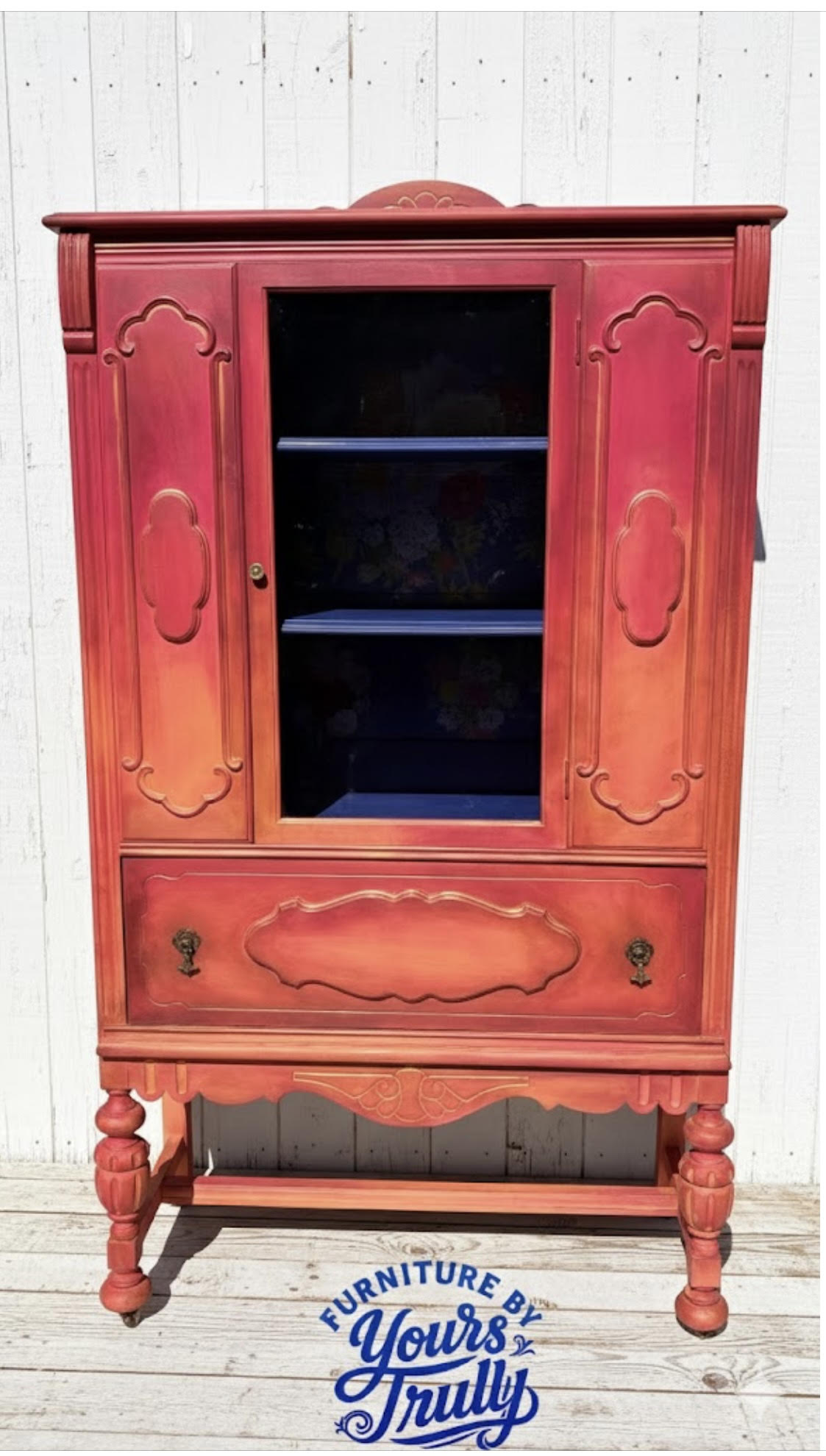
The form here is unmistakably of that lineage: arched crest rail at the top, raised panels framed by fluted pilasters on the doors, a shaped drawer front with applied cartouche, scalloped apron, and four turned legs with ball feet connected by a lower stretcher shelf. The original construction remains intact, including the glass center door and all brass hardware.
The Wet-Blended Gradient
The transformation of this piece centers on color as a vehicle for contemporary reinterpretation. The exterior carries a wet-blended gradient of two Annie Sloan Chalk Paint colors: Capri Pink and Barcelona Orange.
These colors were applied and while still wet they were blended directly on the surface, allowing them to merge and shift organically across the cabinet's architecture. The result is not a hard division between pink and orange, but a continuous transition that reads as:
- 🎨 Coral-pink near the top
- 🌅 Salmon across the middle
- 🧡 Terracotta-orange toward the base and legs
The Art of Wet Blending
This technique requires speed and confidence. Wet blending must be completed before the paint begins to set, and the artist must maintain a consistent gradient across multiple surfaces that differ in orientation and detail.
The carved panels, turnings, and recessed areas present distinct challenges, as the blending must accommodate depth and shadow while preserving the illusion of continuous color flow. The final effect is one of movement and warmth, as though the piece has absorbed light and radiates it back in shifting tones.
Wax Finishing
Clear wax seals the surface, then brown wax adds aging in carved details, turnings, and edges where natural wear would occur
Original Hardware
Brass keyhole escutcheon and drawer pulls with ornate backing plates retain their antique patina
Unrepeatable
Wet blending produces organic variation—no two applications yield identical transitions
"The blending responds to the cabinet's structure, flowing over the curved top edge, wrapping around the carved door panels, highlighting the raised cartouche on the drawer, and saturating the turned legs."
The Napoleonic Blue Interior
The interior of the cabinet offers a complete chromatic and atmospheric reversal. All interior surfaces, including the back wall, side panels, and shelves, are painted in Napoleonic Blue, a deep, saturated navy that absorbs light and creates a sense of enclosure.
Over the blue back panel, floral decoupage paper from the Annie Sloan collection has been applied. The paper introduces pattern, color, and decorative complexity visible through the central glass door. The florals read against the dark blue ground, creating a jewel-box effect that transforms the interior into a curated display space.
The contrast between the warm, gradient exterior and the cool, dark interior is deliberate and dramatic. Opening the glass door reveals an entirely different palette and mood.
Function & Versatility
The central glass door is original and fully functional, opening to provide access to the shelved interior. The single drawer beneath the door section offers closed space for linens, flatware, or smaller items. The lower stretcher shelf between the legs remains open and can hold baskets, books, or decorative objects.
The cabinet's design balances display and concealment, offering multiple zones for both visible curation and hidden storage.
Dining Room
China cabinet or bar storage with visual impact
Living Room
Display case for collections, books, or decorative objects
Bedroom
Wardrobe or linen storage with bold presence
Entryway
Bold focal point with functional storage
Styling & Context
The color palette suits maximalist interiors, eclectic spaces, bohemian aesthetics, or any room where a statement piece anchors the design. The warm exterior works with brass, natural wood, cream, coral, and jewel tones, while the Napoleonic Blue interior offers flexibility in styling with contrasting or complementary colors.
The Napoleonic Blue shelves provide a neutral backdrop for displaying white ceramics, brass objects, glassware, books, or colorful textiles, all of which gain visual intensity against the dark ground.
Care & Maintenance
Dust exterior regularly with soft, dry cloth, paying attention to carved details
Buff waxed surface occasionally to maintain luster and protect blended finish
Avoid harsh chemicals, abrasive cleaners, or water-based products on painted surfaces
Re-apply Annie Sloan Clear Wax every 1-2 years to refresh protection
Clean glass door with glass cleaner applied to cloth (not sprayed directly)
Interior Napoleonic Blue surfaces and decoupage sealed with wax—gentle dusting only
Keep away from direct sunlight to prevent fading of gradient and decoupage
Maintain moderate humidity to preserve wood and prevent warping
When moving, lift from base rather than pulling by legs or doors
A Singular Work
The piece is unrepeatable in its exact gradient. Wet blending produces organic variation, and no two applications will yield identical transitions. This singularity adds to the cabinet's value as a handcrafted object rather than a mechanically reproduced finish.
The combination of period form, contemporary color, and dual-palette interior makes this cabinet a layered work that rewards both distant viewing and close inspection. The turned legs elevate the cabinet's body and give the piece a lighter, more sculptural presence than a flush-to-floor base would allow.